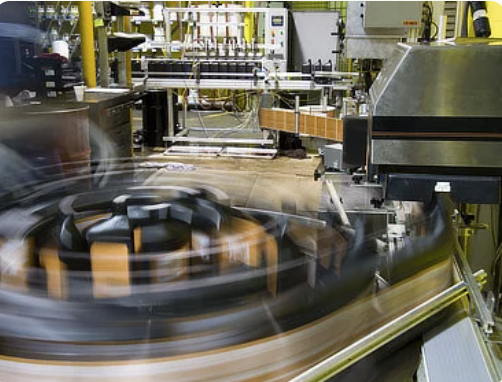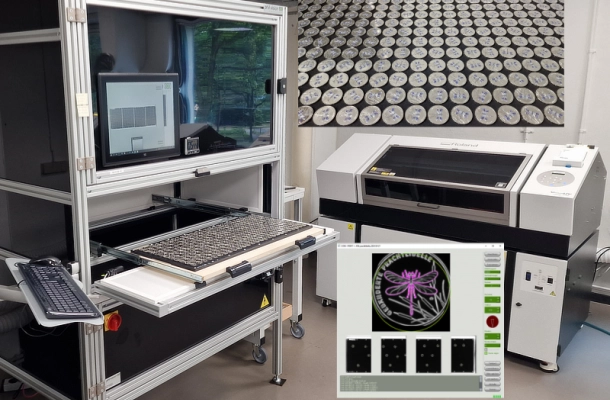
The Hamburg Mint, one of Germany's oldest mints, has been using machine vision since the early 2000s to automate various production steps, such as aligning coins during packaging and quality control.
In another project, we encountered the problem that the precise positioning of coins during the printing process was always very time-consuming. Working closely with the client, we developed a machine vision system over the last 10 months that automates this process and has been successfully used daily since May 2023.

High-quality and precise printing
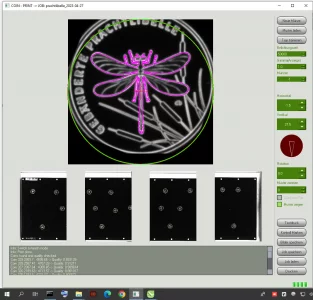
The system recognizes motif details of a coin relief to be colored and sends this data to digital printers, which then print these details accordingly. This leads to more efficient production, significant time savings, and up to a doubling of throughput, since up to 250 coins can be placed on a tray at the same time without the need for complex manual alignment.
The goal of the system is to ensure printing accuracy. If the print is not congruent with the embossed relief of the coin, scrap is produced, which must be minimized at all costs. The permissible deviation during printing must not exceed 50µm.
System architecture and mode of operation
Coin minting unit
This is where the coins are provided with embossed motifs (not part of the phil-vision solution)
machine vision system
The coins are placed manually on a tray, after which their position and rotational orientation are captured by four high-resolution cameras in order to subsequently determine the colorable motif details on the coin relief from the measurement data (position and rotation) and extract the information relevant for printing.
Machine vision algorithm
A specially developed algorithm analyzes the captured image data to identify the exact positions and dimensions of the design details to be printed. This algorithm ensures precise recognition even when the orientation of the coins on the tray varies.
Communication unit
An individual print template is generated from the determined print data and transmitted to the printer in real time to ensure the required accuracy.
Digital printer
The selected design details are precisely printed onto the coin relief. The printing process is designed for maximum accuracy and color fidelity. A printer from Pland is used in this application; software adjustments for other brands are possible at any time.
Packaging unit
After the printing process, the coins are automatically packaged and prepared for delivery.
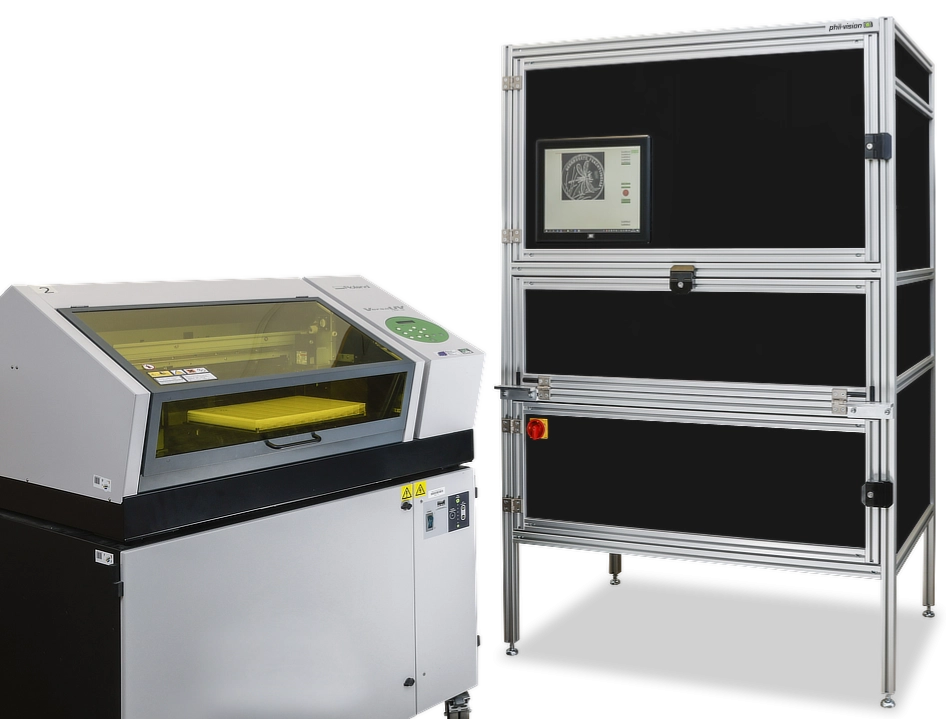
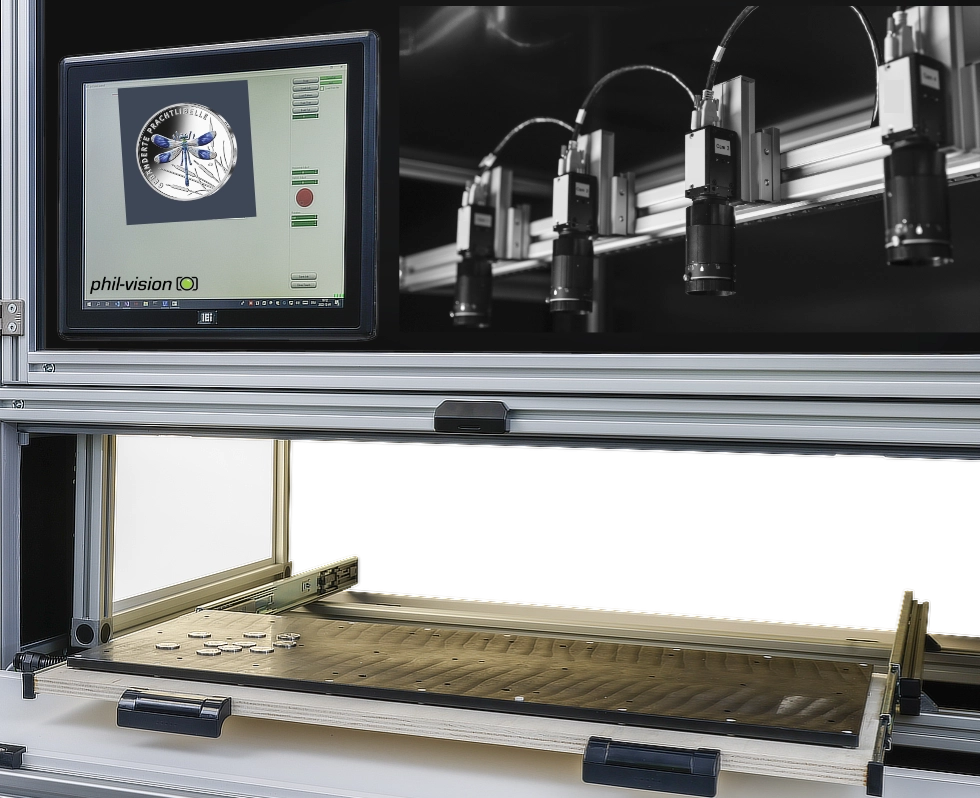
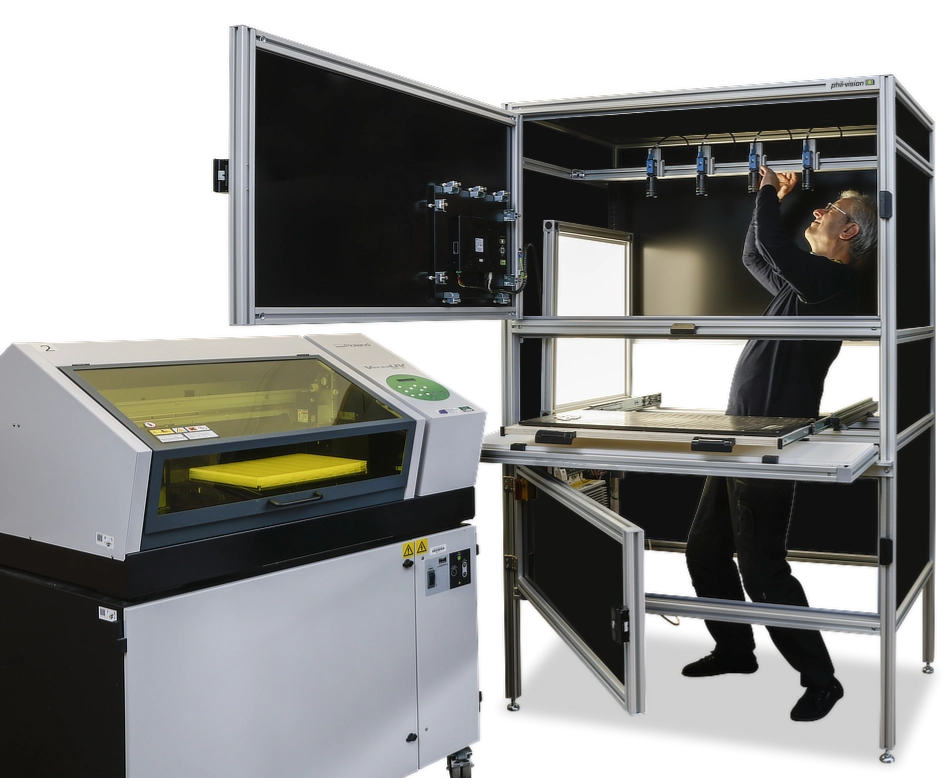
The pvPhotobox machine vision system used for coin printing not only increases efficiency and enables the simultaneous printing of up to 250 coins , but the technology also ensures extremely precise recognition of the design details to be printed and guarantees a perfectly aligned print with an accuracy of 50 µm , thus minimizing waste. The system can process various coin designs and is easily adaptable to new designs.
Intensive collaboration as the key to success
Extensive preliminary work and coordination were necessary to ensure the system functions smoothly. We attribute the high level of acceptance of the pvPhotobox among users primarily to the fact that we involved the operating personnel in the development from the very beginning. Starting with the formulation of requirements down to details concerning operation and handling, all points were intensively discussed not only with management but also with the users.
The result:
- The throughput when printing on the coins has almost doubled through the use of the system.
- The required accuracy of a print image deviation of only 50µm is guaranteed.
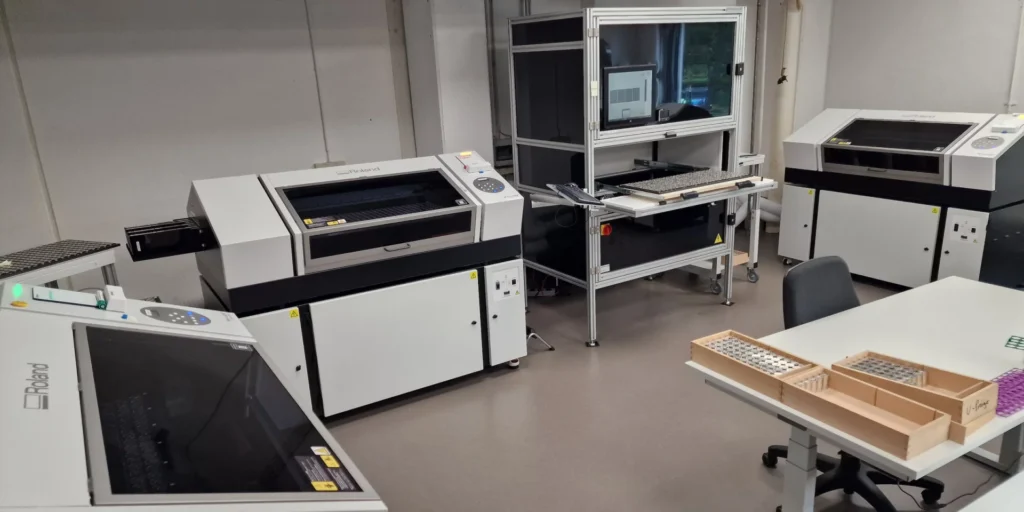
Theoretically, any number of printers can be connected to the system, though a maximum of 8 is practical. The only limits here are set by the time required for the manual loading of the trays. The required evaluation time is 2 seconds per coin, meaning that approx. 5 minutes are needed for a full tray of 250 coins.
Peter Steinbrück, responsible project manager at phil-vision, on the challenges of the project:
“Having already collaborated with the Hamburg Mint on various projects, I was already familiar with potential problems and sources of error. We definitely wanted to achieve the targeted print accuracy of 50µm. For our customer, this goal naturally referred to the finished product and not to our measurement results. Unfortunately, the printers used cannot maintain this tolerance for an absolute measurement by a long shot. While the printers are too inaccurate in terms of absolute measurement, they deliver very reproducible results—a fact we took advantage of to find an acceptable solution by incorporating the printer tolerances into our calibration.”
Guido Beckmann, Head of the Hamburg Mint, summarizes the collaboration with phil-vision as follows:
“phil-vision handled the component selection and programming in this project and provided comprehensive support during integration. The collaboration was very professional and goal-oriented.
In every phase of the project, great emphasis was placed on precision and detail. The fast response times, project management, and general high level of expertise were also positive aspects.”
Hamburg Mint
The Hamburg Mint is Germany's oldest minting facility. Its history dates back to the 9th century. The first known coin minting from Hamburg dates back to the year 834. Today, the Hamburg Mint is a legally dependent state operation of the Free and Hanseatic City of Hamburg. Supervision is exercised by the city's Ministry of Finance. With around 40 employees, it is one of five mints in Germany that produce coins on behalf of the Federal Ministry of Finance to supply the population and trade.
More interesting application reports
Automated wall production for prefabricated houses
Automated tool recognition and measurement based on AI and 3D machine vision
High-precision hole detection in steel strips with machine vision
Visual inspection of cooling boxes for the pharmaceutical and food ndustriy
Seal inspection of food packaging
Perfect fold quality through machine vision
High-speed video recordings:
Optical measurement and inspection of rubber seals
Machine vision keeps the high-rack warehouse organized
Bird-tracking System for wind turbines