Bird tracking system for wind turbines protects endangered birds
Wind turbines must be shut down due to increasingly stringent species protection regulations when protected bird species come near. A machine vision system from phil-vision uses artificial intelligence to eliminate the risk of birds being struck by the wind turbines and minimizes costly downtime.
For the construction and operation of wind turbines, nature conservation requirements have increased enormously in recent years. For example, wind turbines surrounded by a certain radius of wind power-sensitive bird species generally have to be shut down for a few days whenever field work such as plowing, threshing, or mowing takes place there. During these times, birds face an increased risk because they spend more time foraging over these fields.
Even if protected birds nest near existing facilities, their operation may only be restricted. Consequently, round-the-clock shutdowns during the breeding season—for instance, from March to August—are increasingly becoming a requirement of permits.
However, every day that a wind turbine generates no electricity diminishes the profitability of the facility. Despite the existing political will to expand the use of renewable energy over fossil fuels, the construction of wind turbines has therefore dropped sharply, largely due to nature conservation regulations.
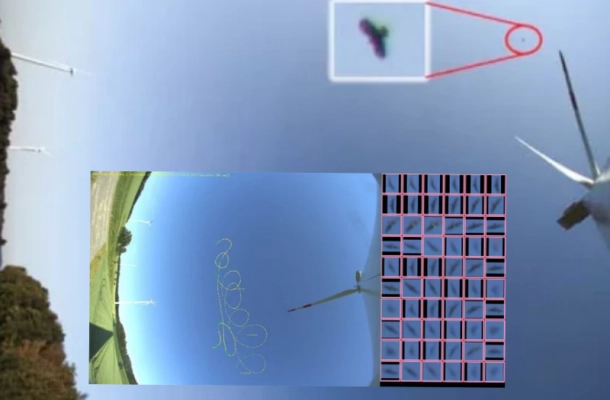
Using machine vision and artificial intelligence, this problem is now intended to be solved in a way that ensures the necessary profitability for wind farm operators while also respecting the needs of nature conservation. To avoid long, costly shutdown periods when no animals are actually in danger, Bürgerwindpark Hohenlohe GmbH, with the support of phil-vision GmbH, developed a system capable of detecting, localizing, and tracking the flight paths of large raptors. The goal is to shut down wind turbines in a targeted manner only when protected birds come within a certain distance of them.
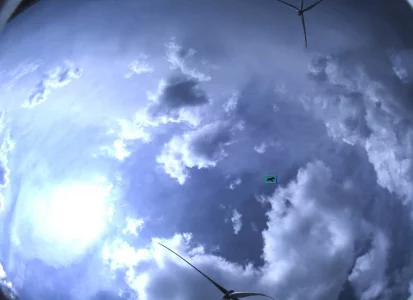
Bürgerwindpark Hohenlohe GmbH, together with phil-vision GmbH, is developing a system that can detect, localize, and track the flight paths of large raptors.
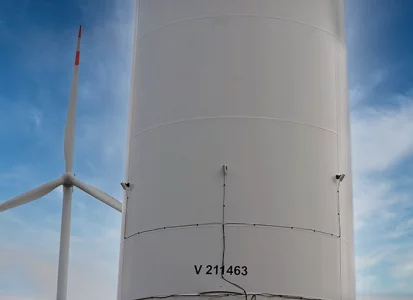
Six industrial color cameras with resolutions of 6 or 20 megapixels in weatherproof protective housings mounted on the mast of a wind turbine capture images to monitor the airspace around the turbine.
A Demanding Task
According to phil-vision founder Gregor Philipiak, detecting and classifying birds to subsequently decide whether they belong to a protected species is an extremely demanding task:
"The fauna conditions vary at every wind turbine site, which is why it is necessary to create individual conservation concepts. With an initial monitoring system, we first determine the specific requirements in order to design the target system appropriately for each facility."
According to Philipiak, the results so far are promising: "We currently have around ten test systems installed. Such a system consists of six industrial color cameras with resolutions of 6 or 20 megapixels, which are attached in weatherproof protective housings to the mast of a wind turbine and capture images to monitor the complete airspace around the turbine."
To be able to capture the entire surroundings in a 360° all-around view, special wide-angle lenses are used to monitor such wide fields of view.
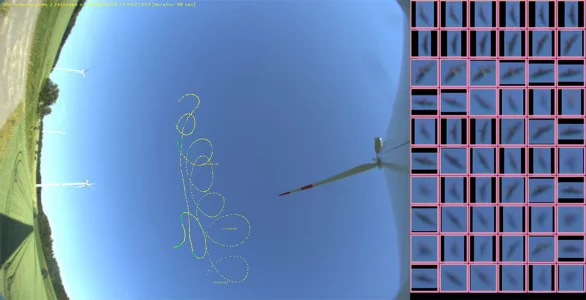
The program tracks the flight paths of protected birds until they no longer pose a threat to the operation of the wind turbine.
Hundreds of thousands of images
The evaluation of the captured images and the reliable detection of endangered birds represents the real art in this application, says Philipiak: "Our system works on the basis of deep learning processes and requires for the training phase just under 400,000 images of birds of different species, at different distances and with various flight positions. Added to this are around 100,000 further images per negative instance, e.g., of insects, airplanes, or helicopters, as well as the captured images with local peculiarities." From this large number of training images, a powerful development system automatically creates a decision tree and a classifier, which serves as the basis for differentiation in the later operational phase.
"By using deep learning methods, we thus create an intelligent system that automatically detects the animals in question against a wide variety of backgrounds and under variable conditions, and distinguishes them from potentially similar objects such as airplanes or flies," explains Philipiak.
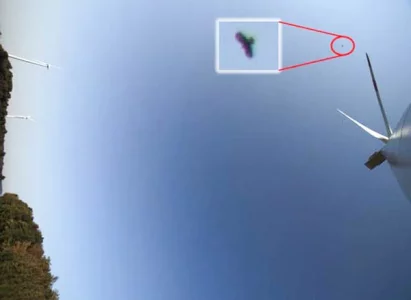
Detecting flight paths
For optimization, the phil-vision system operates in two steps and with different resolutions: Using 6-megapixel cameras, all moving objects are first detected. By switching to cameras with 20-megapixel resolution, these objects can then be identified with higher accuracy. This is how the system determines whether a found object is a bird at all and subsequently whether the animal belongs to a species under nature conservation.
The program tracks the flight paths of protected birds until they are no longer recognizable and thus no longer pose a potential threat to the operation of the wind turbine. If a protected bird falls below the specified minimum distance to the wind turbine, a corresponding signal is sent to its control system in order to slow down the system in good time.
For economic reasons, one of the primary goals of a wind farm is to have as few false triggers as possible. Through the use of powerful deep learning algorithms, we have been able to meet this requirement better and better in the course of programming and significantly reduce the number of false shutdowns.
More interesting application reports
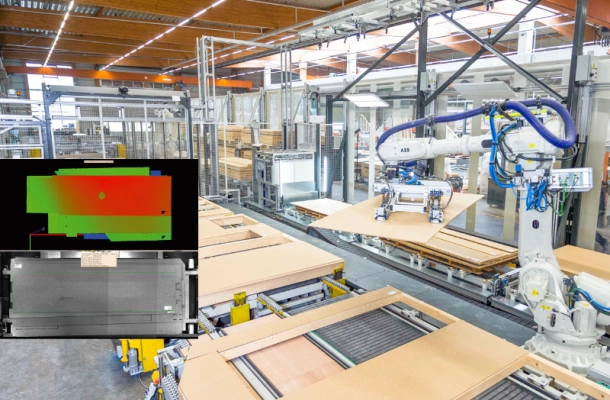
Automated wall production for prefabricated houses
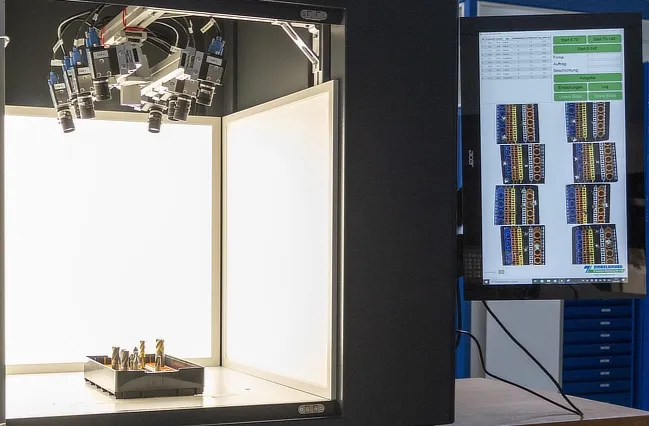
Automated tool recognition and measurement based on AI and 3D machine vision
High-precision hole detection in steel strips with machine vision
Visual inspection of cooling boxes for the pharmaceutical and food ndustriy
Seal inspection of food packaging
Perfect printed coins thanks to machine vision
Perfect fold quality through machine vision
High-speed video recordings:
Optical measurement and inspection of rubber seals
Machine vision keeps the high-rack warehouse organized