Contact Image Sensor Detects Tiny Holes in Steel Strips
InDeep Solutions and phil-vision have developed an innovative inspection system for TI Fluid Systems that detects the smallest holes in steel strips for the automotive industry with maximum precision.
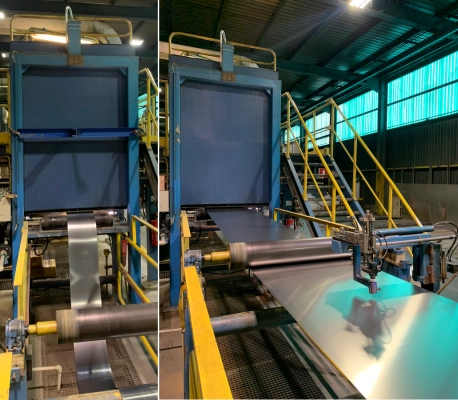
Our customer InDeep Solutions specializes in complete solutions for production quality control and industrial process monitoring, with a focus on inline inspection across various production lines. With more than a decade of experience in process automation, the company has developed an innovative inspection system for TI Fluid Systems. The company produces strip steel for the automotive industry, which is further processed into tubes for brake and fuel lines. Depending on the end customer's specifications, these steel strips are coated with copper or nickel.
Weaknesses of the Previous Inspection System
Previously, TI Fluid Systems used a camera-based system mounted 3 meters above the steel strips. This system required complex calibration and was frequently inaccurate, leading to numerous false detections and operational interruptions. These shortcomings necessitated the development of a more reliable inspection solution.
System Requirements
The inspection system must be capable of detecting any potential hole with a size of at least 1 mm in steel strips moving at a speed of 95 meters per minute (1580 mm/s). Given the critical application of these steel strips in hydraulic lines for brake and fuel systems in motor vehicles, precise hole detection is crucial to prevent serious consequences.
Development of the new inspection system
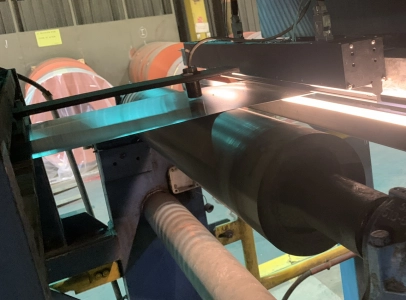
InDeep initially experimented with a laser profiler to meet the inspection requirements. However, tests showed that the frequency and resolution were insufficient to detect the small holes required by TI Fluid Systems.
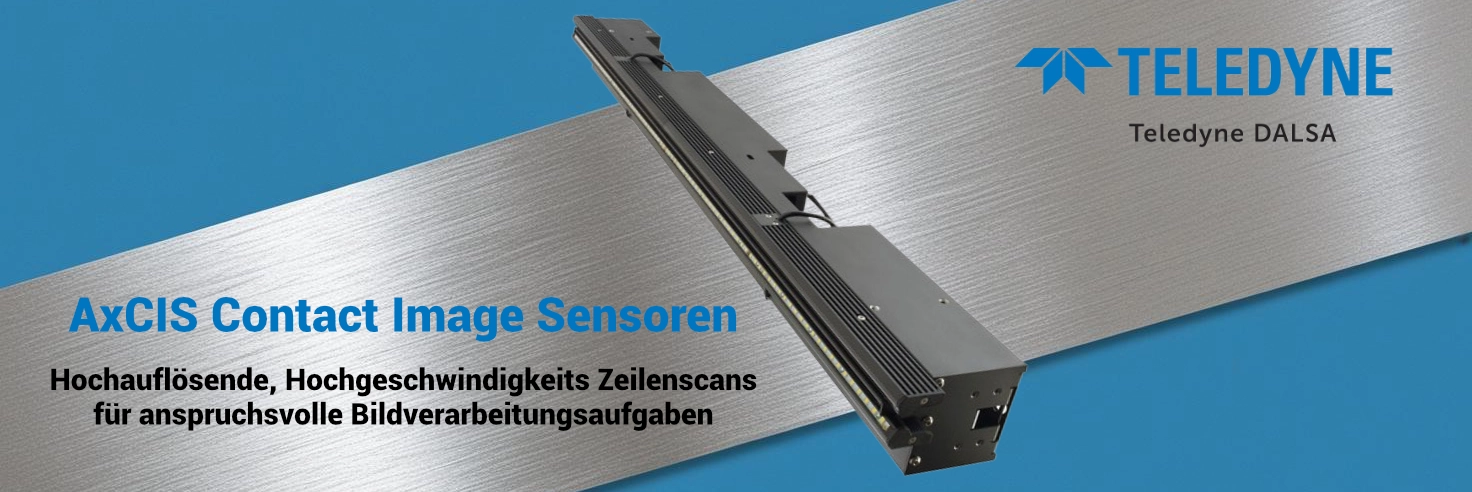
In search of a suitable solution, they turned to the machine vision experts at phil-vision. Thanks to their extensive experience from numerous integration projects with Teledyne Dalsa components, they proved to be the ideal partner for selecting suitable camera technology. The specialists suggested using the AxCIS Contact Image Sensor—originally developed for battery inspections and print inspection—for a completely different application and using alternative lighting to master the task.
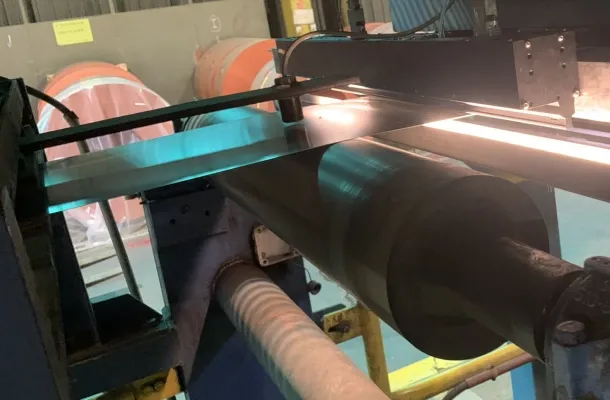
As a result, InDeep decided to test a Contact Image Sensor and chose the compact AxCIS Mono (18628×2) from Teledyne Dalsa, a high-resolution, high-speed line scan sensor specially designed for demanding machine vision applications. Combined with an Xtium2 CameraLink HS frame grabber, this sensor enables a short working distance within a compact housing and simplified installation without the need for complicated cabling, complex alignment, or calibration. Thanks to the fiber optic data connection, the AxCIS is also well-suited for use in harsh environments.
The sensor enables a high acquisition rate. For this application, it was set to 10 kHz, resulting in a minimum resolution of 0.15 mm in the direction of travel. The resolution across the width of the steel strip is even higher: 0.022 mm. This accuracy ensures reliable defect detection.
The measurements are captured in blocks of 4,000 lines, processed, and transmitted block by block. This reduces the CPU load while maintaining a fast response time of 0.4 seconds. Each generated image is analyzed immediately after release. While processing is underway, the next image is generated in parallel.
Tests and Results
InDeep conducted extensive tests, demonstrating the system's reliability in detecting all holes without false alarms. The achieved resolution exceeds that of the old camera-based system, while the number of false alarms was significantly reduced. In addition, the system is able to precisely determine the position of each hole.
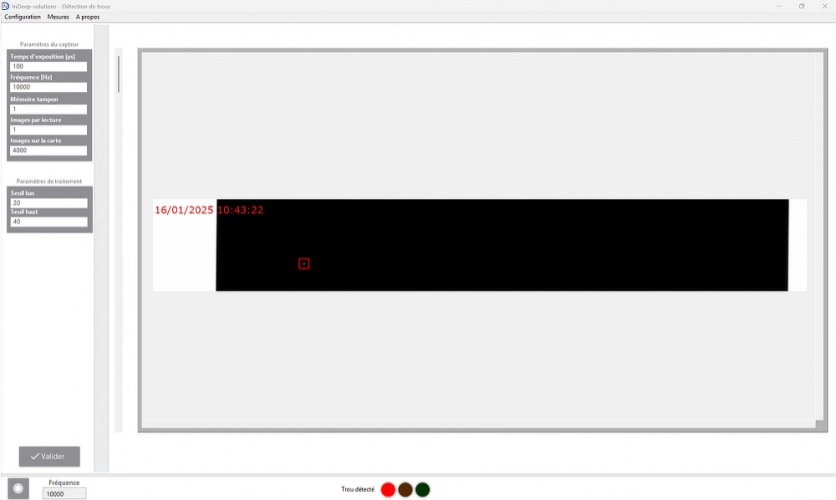
InDeep developed custom software for the customer that delivers high-resolution images and improves defect detection through special feature-highlighting functions. This software plays a crucial role in the system's efficiency and is highly appreciated by TI Fluid Systems.
The software is very user-friendly. Configuration is simple, and once completed, no further human intervention is required.
Example image showing a defect that is barely noticeable.
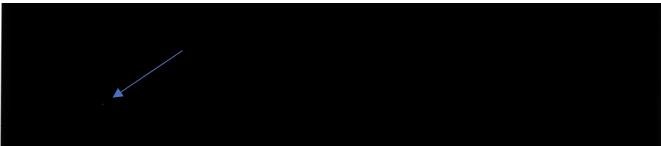
The defect becomes visible in the magnified view.

Defect detection is based on exceeding threshold values. First, the edge is defined as the first point below the level specified in the configuration tab. Holes are then detected when the value exceeds the maximum value also defined in the settings. The following figure shows an example of the detection.
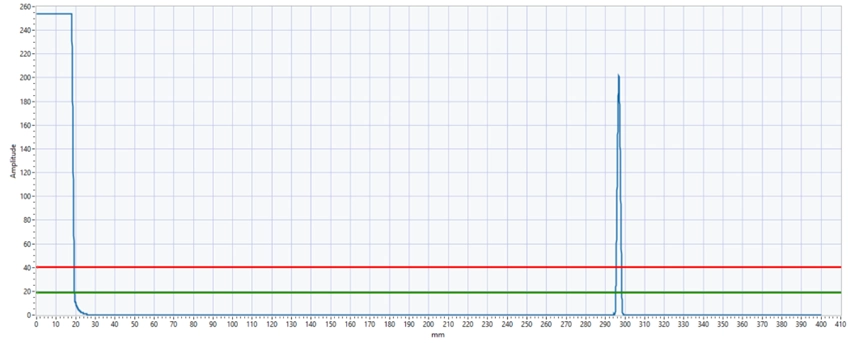
Due to the very high resolution and the small size of the holes, defects are marked with a red rectangle so operators know where to look. The software can display the last 10 detected holes. In addition, all detected defects are saved on the hard drive for 6 months.
Collaboration with phil-vision
After inDeep Solutions initially planned to implement the project with a laser profiler, but it failed to deliver the desired results, they turned to phil-vision. Due to their many years of experience from a wide variety of integration projects with cameras and machine vision components from Teledyne Dalsa, the system integrator from Puchheim was the perfect partner for selecting and supplying the appropriate components.
The specialists recommended "repurposing" the AxCIS Contact Image Sensor—originally developed for battery and print inspection—and using a different type of lighting to solve the task. Since the AxCIS sensors are essentially compact, quasi-telecentric line scan cameras, they are also ideally suited for high-precision measurement tasks. phil-vision subsequently arranged for a test sensor to be loaned out for feasibility studies, assisted with sensor timing, programming, and software integration, and thus contributed to the successful implementation of the inspection system.
Summary
InDeep Solutions has successfully developed an advanced inspection system for TI Fluid Systems that solves the challenges of the previous system. By using the AxCIS sensor from Teledyne Dalsa and customized software, the new system offers superior resolution, reliability, and accuracy in detecting small holes in steel strips. The collaboration with phil-vision and the use of the high-speed contact image sensor from Teledyne Dalsa were crucial in achieving these results and represent a significant improvement in production quality control for the customer.
inDeep Solutions specializes in the development of innovative, high-performance solutions tailored to the specific needs of modern industry. Founded on the principles of precision, efficiency, and technological competence, the company is dedicated to developing advanced systems that streamline production processes, improve quality control, and increase operational reliability.
With a strong focus on automation and detection technologies, InDeep Solutions is a reliable partner for customers looking for cutting-edge tools to tackle demanding challenges. The developed solutions combine robustness with user-friendliness, ensuring seamless integration into existing workflows.
The phil-vision GmbH is a specialist in industrial machine vision and computer vision with a comprehensive range of services. As a value-added distributor of machine vision components from leading manufacturers, paired with many years of integration expertise, we are not only a system integrator offering clear added value for our customers, but also the ideal advisor and partner for integrators in selecting suitable machine vision components.
Drawing on many years of experience, we develop machine vision subsystems and implement intelligent, customized solutions for demanding image processing tasks across a wide range of industries and applications. Our service portfolio is rounded out by a comprehensive training program covering a wide variety of topics in machine vision.
Want to know more – write to us!
More interesting application reports
Automated wall production for prefabricated houses
Automated tool recognition and measurement based on AI and 3D machine vision
Visual inspection of cooling boxes for the pharmaceutical and food ndustriy
Seal inspection of food packaging
Perfect printed coins thanks to machine vision
Perfect fold quality through machine vision
High-speed video recordings:
Optical measurement and inspection of rubber seals
Machine vision keeps the high-rack warehouse organized
Bird-tracking System for wind turbines