
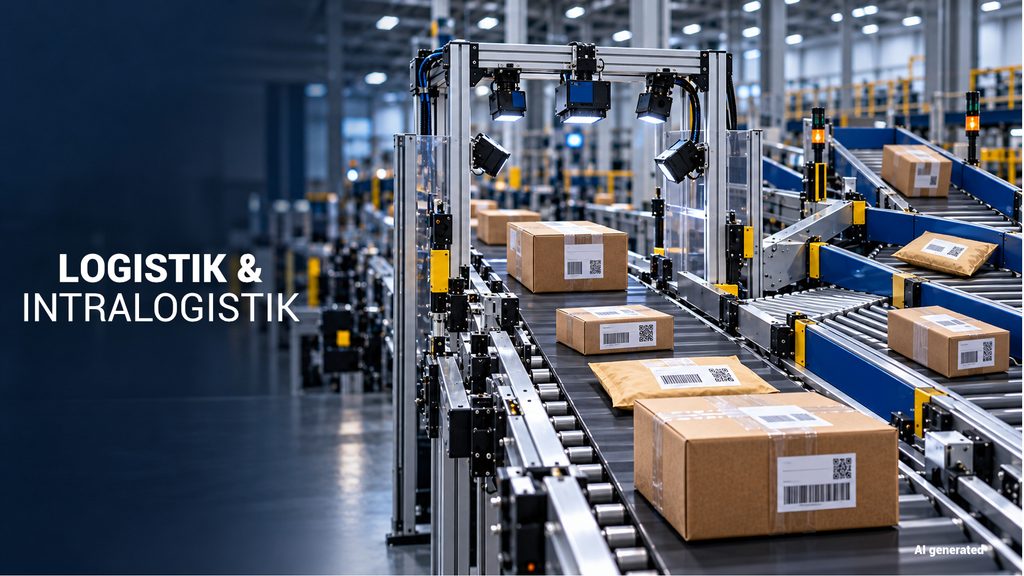
Camera-based identification and automation for logistics
Fast material flows require reliable identification. Unreadable labels, incorrect assignments, or incomplete shipments lead to delays and increased manual effort.
phil-vision machine vision systems read and verify 1D and 2D codes as well as plain text, detect and position objects, and determine their dimensions and volume. In addition, they check shipments for completeness, cross-reference labels, delivery notes, and transport containers, and transmit the results to higher-level control, warehouse management, or ERP systems. Even poorly printed, damaged, or unfavorably positioned markings can be reliably processed using appropriate camera, lighting, and evaluation technology.
- Reliable reading and verification of codes at high speeds
- Fewer misallocations and manual rework
- Seamless traceability
- Precise position and volume measurement
- Easy integration into existing IT and automation systems
Typical applications for machine vision in logistics
Reading and verifying codes
Reading 1D barcodes, QR and DataMatrix codes, and other markings. In addition, the readability and print quality of the codes can be evaluated.
OCR and plain text
Reading addresses, shipping information, item numbers, serial numbers, and batch data.
Identification without codes
Recognition of products or packaging based on individual visual features when no barcodes, labels, or other markings are to be used.
Completeness check
Inspection of containers, order pickings, workpiece carriers, and shipments for quantity, presence, and correct assignment.
Track & Trace and Shipment Assignment
Automatic matching of parcel labels, delivery notes, accompanying documents, and transport containers for seamless traceability.
Object Recognition and Sorting
Classification of products or shipments by shape, size, color, and other visual features.
3D Measurement and Volume Measurement
Determination of dimensions, height, and volume of parcels and objects for warehouse planning, sorting, transport, and automated handling.
Position Determination and Robot Positioning
Determination of the position, location, and orientation of objects, as well as the transfer of coordinates to robot and handling systems.
Which objects, codes, or markings would you like to detect, measure, or position? Send us sample images and details regarding conveyor speed, working distance, measuring range, and required interfaces. We will check feasibility and develop the right solution.