
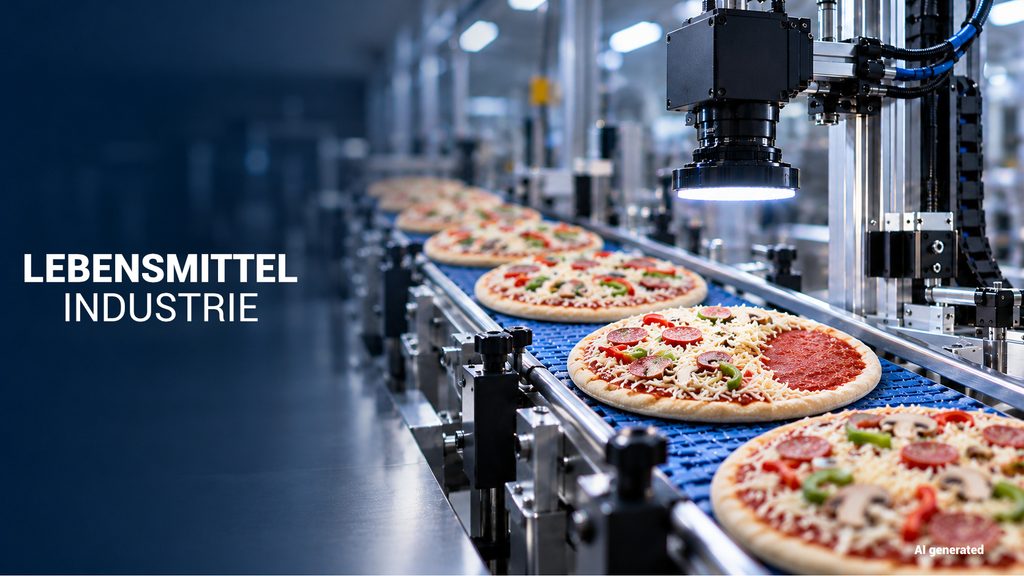
Automated quality control for food and beverages
In food and beverage production, various products must be reliably inspected, sorted, and packaged at high production speeds. Variations in shape, color, fill level, or packaging, as well as contamination, faulty labeling, and leaking seal seams, can lead to rejects, customer complaints, or production downtime.
phil-vision develops camera-based systems for the automated inspection of food, beverages, and packaging. The solutions inspect products for defined quality characteristics, check fill levels and closures, examine sealing areas, read codes, and sort products by color, size, shape, or quality. Depending on the task, classic 2D machine vision, 3D metrology, deep learning, or hyperspectral imaging are used.
- Automatic quality control directly in production
- Reproducible inspection at high cycle and line speeds
- Reduction of scrap, rework, and complaints
- Reliable sorting and classification
- Documented inspection results and traceability
- Integration into existing production and packaging lines
- Hygienic and cleaning-resistant system design available upon request
Our solutions are precisely tailored to the requirements of the food and beverage industry – flexible, scalable, food-safe where required, and resistant to industrial cleaning processes.
Get started now and find out which solution fits your company – completely non-binding!
Typical applications for machine vision in the food and beverage industry
Product inspection
Inspection of shape, color, surface, size, and other defined quality characteristics. Faulty, damaged, or incomplete products can be detected and automatically rejected.
Seal inspection
Inspection of sealing areas for wrinkles, bubbles, inclusions, product residue, and other contaminants that could impair leak tightness or shelf life.
Film Inspection
Continuous inspection of packaging films for holes, tears, inclusions, bubbles, discoloration, contamination, and deviations in surface or coating structure.
Sorting and classification
Categorization of food products by color, size, shape, degree of ripeness, or quality grade. Potential applications include sorting fruit, vegetables, baked goods, or other variable natural products.
Foreign object and anomaly detection
Detection of visible foreign materials, contaminants, and product deviations that can be distinguished using specialized camera technology. Technical feasibility depends on material, size, contrast, packaging, and production speed.
Fill level and closure inspection
Checking whether bottles, jars, cans, or pouches are correctly filled and completely sealed. Underfilled, overfilled, or incorrectly sealed products can be automatically detected.
Shape, position, and volume measurement
Non-contact measurement of size, height, contour, and volume using 2D or 3D machine vision. This allows portions to be compared, products to be classified, or processes to be monitored.
Packaging inspection
Inspection of packaging for damage, deformation, tears, missing components, and other defined deviations.
Label, print, and code verification
Checking labels and print information for presence, position, legibility, and correct assignment. Barcodes, QR and DataMatrix codes, as well as batch and date information, can be read and verified.
Track & Trace
Linking product, batch, and identification data with inspection results for traceable assignment across production and packaging steps.
Process Monitoring
Image and video recording of fast production processes for analyzing sporadic errors and optimizing feeding, processing, and packaging processes.
Position detection and automated handling
Determining position and orientation for robot, sorting, and packaging processes.
Would you like to inspect, sort, or trace food, beverages, or packaging automatically? Send us sample products, typical defect examples, and details on the inspection area, product variants, and production speed. Based on this, we analyze the technical feasibility and develop the appropriate solution.