
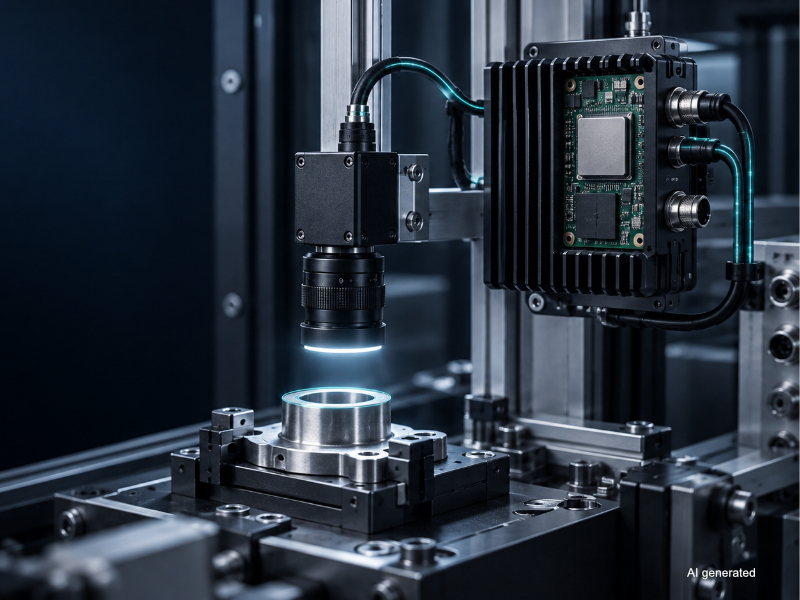
Not every machine vision task requires a powerful industrial PC in a control cabinet. In many machines, devices, and OEM products, image acquisition and evaluation should be as compact, energy-efficient, and close to the actual process as possible. That is precisely what embedded vision stands for.
The camera and computing unit do not necessarily need to be housed in the same enclosure. In fact, it is often more sensible to combine a suitable industrial camera with a separate, compact computing platform. This allows camera technology and processing power to be optimally tailored to the application independently of each other. This could be a simple presence check, highly accurate position determination, 3D evaluation, or an AI-based inspection directly at the machine.
At phil-vision, we develop embedded vision solutions based on real-world applications. We select the camera, optics, lighting, and computing platform, optimize the algorithms, and integrate the complete system into the machine or product. After all, a vision system does not become compact simply by transferring an existing PC application onto smaller hardware. Hardware and software must be developed together for the target system.
What is Embedded Vision?
Embedded vision combines industrial image acquisition and machine vision with a dedicated computing platform integrated into the machine or product. Image processing takes place locally and as close as possible to the camera or the process. A central industrial PC or cloud connection is not required for the actual inspection decision.
Compact ARM- or x86-based systems are typically used for this purpose. These frequently run on embedded Linux and can be supplemented by GPUs, NPUs, FPGAs, or other hardware accelerators depending on the task. In many applications, the camera remains a standalone industrial component. For example, it can be connected to the computing platform via GigE Vision, USB3 Vision, or MIPI CSI-2.
Typical platforms and form factors include:
- compact ARM-based industrial computers
- system-on-modules with custom or standardized carrier boards
- compact edge computers with CPU and GPU
- platforms with NPUs or other AI accelerators
- FPGA-based systems for highly deterministic processing
- custom-developed computing units for machinery and OEM products
- smart cameras for clearly defined tasks
A smart camera is therefore one possible form of embedded vision – but by no means the only one.
Particularly in more demanding applications, a separate computing platform often offers greater freedom regarding camera selection, processing power, interfaces, operating system, and software architecture. Embedded does not simply describe the physical size of the hardware. The crucial factor is that the machine vision function, processing power, power consumption, interfaces, operating system, and lifecycle are planned as part of the overall system.
When is Embedded Vision useful?
Embedded vision offers advantages when machine vision needs to be integrated compactly and decentrally into a machine or product. Instead of transmitting image data over long distances to a central computer, processing takes place as close as possible to the camera. Often, only results, measured values, positions, or status information then need to be transmitted to the machine control system.
Typical application areas include:
- compact inspection modules in machinery and systems
- OEM devices with integrated recognition or measurement functions
- decentralized quality inspection across multiple stations
- camera-guided robotics
- mobile systems
- identification, OCR, and code reading directly at the process
- status and process monitoring
- AI-based classification or defect detection at the edge
- 3D evaluations with local preprocessing
- machines with limited installation space for traditional PC technology
Short data paths can enable low and easily predictable response times. Local processing also reduces network load and can keep sensitive image data within the machine.
For series machines or OEM products, a precisely dimensioned platform can also be more economical and easier to integrate than an oversized industrial PC at every station. However, these advantages only materialize with careful design. Development effort, computing power, thermal management, update capability, interfaces, and the long-term availability of the components used must be taken into account from the very beginning.
Embedded platform or industrial PC?
The boundary between embedded systems and traditional industrial PCs is fluid. For us, therefore, it is less important which category a device formally belongs to. What matters is which platform makes technical and economic sense for the respective machine vision task.
Embedded platform
A system-on-module, a compact ARM computer, or a small edge computer offers great freedom in camera selection, software, and hardware acceleration. Depending on the application, multi-core CPUs, GPUs, NPUs, or FPGAs can be used, for example.
Such platforms are particularly suitable when:
- installation space is limited
- the processing unit is to be mounted close to the camera
- low energy consumption is important
- a specific computing architecture is ideally suited to the task
- larger production volumes are planned
- a solution is intended to become a long-term component of a machine or OEM product
In return, the requirements for software architecture, driver integration, cooling, update concepts, and system maintenance increase.
Smart Camera
A smart camera combines a sensor, processor, and interfaces within a single camera housing. It is particularly well-suited for clearly defined tasks that can be reliably handled with the available processing power and existing interfaces.
However, for many customer-specific or computationally intensive tasks, processing power, memory, camera selection, and expandability are more restricted compared to a separate embedded platform.
PC-based machine vision system
An industrial PC remains the right choice when numerous cameras, very high data rates, large 3D data volumes, extensive user interfaces, or frequently changing tasks are required.
A classic PC also frequently offers greater performance reserves and flexibility for development, data analysis, and the training of AI models. Therefore, our selection is not driven by buzzwords. We evaluate computational load, latency, frame rate, installation space, power consumption, environment, production volume, software requirements, and expected future development.
The objective is: As compact as sensible – with precisely the performance reserves required for actual operation.
Which processing unit fits the task?
Modern embedded systems frequently combine different processor types.
CPU
A CPU typically handles process control, classic machine vision, communication, and general software logic. For many embedded applications, ARM processors offer an attractive balance of processing power, power consumption, and physical size.
GPU
GPUs are particularly suitable for highly parallelizable computations. These include, for example:
- Deep learning inference
- Image filters
- Specific 3D calculations
- Point cloud processing
- Parallelizable classic machine vision
NPU and AI accelerators
NPUs and other AI accelerators are specifically designed for neural networks, enabling high inference performance with comparatively low power consumption. They can be especially interesting when AI needs to be operated directly within a compact machine component.
FPGA
FPGAs are suited for the very fast, deterministic processing of data streams. For instance, they can handle preprocessing, synchronization, or specialized signal processing directly within the data path. However, the highest nominal processing power is not automatically the best choice. Memory bandwidth, supported data types, memory size, drivers, toolchains, and actual utilization significantly impact achievable speed. Furthermore, camera acquisition, data transfer, copy operations, and post-processing are all part of the actual cycle time. Therefore, we do not rely solely on individual benchmarks; we measure the complete processing chain on the intended target hardware using real images under practical performance and temperature conditions.
Linux and ARM as the foundation for compact vision systems
For many embedded vision applications, Linux provides a powerful and flexible platform. In particular, ARM-based systems today combine high processing power with low energy consumption and a compact design. At the same time, professional Linux distributions, development tools, and extensive libraries for machine vision and communication are readily available.
Depending on the application, very different platforms can be advantageous – ranging from small systems-on-module to powerful edge computers with integrated GPUs. For us, a specific processor family or manufacturer is not what matters most. The platform must fulfill the requirements of the specific application:
- Sufficient processing power
- suitable camera interfaces
- stable drivers
- long-term availability
- controllable power consumption
- sufficient memory resources
- suitable accelerators
- industrial-grade interfaces
- reliable update and maintenance concept
Particularly in embedded systems, the quality of the overall hardware and software ecosystem is often more important than a single performance figure from the datasheet.
Image capture remains the crucial starting point
Even on a high-performance embedded platform, the rule holds true: what is not stably visible in the image cannot be reliably inspected by any algorithm. Optics and lighting determine contrast, sharpness, and reproducibility. Short exposure times require sufficient light. Higher resolutions, in turn, increase data rates, memory requirements, and computational load.
Depending on the application, the camera is connected via various interfaces. Industrial standards such as GigE Vision or USB3 Vision allow a clear separation between the camera and the computing platform while offering a wide selection of industrial cameras. In particularly compact systems, board-level cameras can also be connected directly to the processor via MIPI CSI-2. MIPI enables very compact and energy-efficient systems, but places higher demands on drivers, cable length, and the precise coordination of camera and platform. Triggers, flash control, and digital inputs and outputs must also be timed correctly relative to the process.
Especially with moving objects, a cleanly defined relationship between the capture time and the inspection decision is more important than a high average frame rate.
Classic machine vision and Edge AI
Many embedded tasks can be solved very efficiently using classic machine vision:
- Finding edges
- Measuring geometries
- Reading codes
- Determining features
- Comparing defined patterns
- Determining positions
Such methods are fast, transparent, and often require comparatively little computing power.
Deep learning becomes relevant when defects vary widely, surfaces exhibit natural fluctuations, or objects cannot be reliably described by fixed rules. Training is typically performed on powerful development or server hardware.
For subsequent operation, the completed model is transferred to the embedded platform and optimized there for the CPU, GPU, NPU, or another available accelerator. Reduced computational precision, smaller input images, or adapted network architectures can significantly reduce memory requirements and runtime. However, every optimization must be re-validated using representative data. A model that functions reliably on a development PC may exhibit different behavior after conversion or quantization.
In practice, we frequently employ hybrid methods: AI localizes or classifies variable features, while classic algorithms measure geometries, check results for plausibility, and make clearly defined tolerance decisions.
Developing software for embedded systems
Embedded software has to do more than just run a working machine vision algorithm. Upon startup, it needs to boot reliably, manage resources efficiently, handle communication errors, and remain maintainable over many years. Especially with Linux-based embedded systems, the operating system and application software are therefore integral parts of the overall system concept.
Depending on the application, a robust architecture includes:
- efficient image buffers without unnecessary data copying
- parallel processing of image acquisition, analysis, and communication
- controlled CPU, GPU, and memory utilization
- watchdog and self-diagnostics
- defined error states
- recipe and parameter management
- logging of relevant results and system states
- secure update and recovery strategies
- clearly versioned software, models, and configurations
- automatic system startup
- reproducible software images
- remote diagnostics capabilities
phil-vision develops close to the hardware in C++ and, depending on the task, utilizes HALCON, OpenCV, Common Vision Blox, CUDA, and FPGA tools, among others.
We implement applications for Windows and particularly Linux-based systems, integrating them with custom user interfaces and industrial interfaces.
Thermal management, power, and long-term operation
High computing performance requires electrical power and generates heat. This is especially true for compact systems featuring powerful CPUs, GPUs, or other accelerators. Inside a sealed enclosure, a platform may throttle its clock speed once temperature or power limits are reached. A prototype that performs quickly in the lab will therefore not automatically maintain its cycle time during continuous operation in a warm machine. For this reason, we evaluate power consumption, cooling concepts, and computing performance together.
These include:
- ambient temperature
- airflow
- mounting
- degree of protection
- enclosure
- Heat dissipation
- Additional heat sources in the immediate vicinity
Stress tests must simulate the most unfavorable yet permissible operating scenario—not just a brief benchmark right after startup. Equally important are available storage reserves and the lifespan of flash memory. Unlimited storage of images or log data can destabilize an embedded system in the long run. Data volumes, retention periods, and overwriting strategies must therefore be defined deliberately.
Integration into machines and OEM products
The processing unit of an embedded vision system is not an isolated machine vision PC. It becomes part of the machine or product. The results of the machine vision must therefore be directly usable for the higher-level process.
Depending on the application, the system communicates via:
- digital inputs and outputs
- Ethernet
- serial interfaces
- OPC UA
- fieldbus
- customer-specific protocols
with PLCs, robots, master computers, or other machine components.
Additional requirements arise for OEMs:
- Will the compute platform and camera remain available throughout the planned product lifecycle?
- How can the operating system and application software be installed in a reproducible manner?
- How are software updates performed?
- How are configurations backed up?
- Who is authorized to modify parameters?
- How can diagnostic information be retrieved?
- How are defective devices replaced?
- How can a replacement device be quickly restored to the correct state?
We define these points together with the machine or product manufacturer. This prevents the creation of an isolated prototype, resulting instead in a series-ready and long-term operable machine vision function with clear interfaces and responsibilities.
From feasibility to the target platform
1. Define inspection task and system boundaries
We clarify features, cycle time, accuracy, installation space, environment, batch size, and interfaces. At the same time, we also look closely at the requirements for the computing platform, operating system, and machine integration from an early stage.
2. Testing the image concept and algorithm
Using real parts, we examine cameras, optics, and lighting, as well as traditional and AI-based methods. The primary focus here is on reliably solving the actual machine vision task.
3. Selecting the computing platform
We choose a suitable platform based on the actual computing requirements. In doing so, we consider CPU performance, GPU, NPU or FPGA support, memory, camera interfaces, power consumption, installation space, and long-term availability.
4. Measuring computing requirements on the target hardware
We benchmark the complete processing pipeline on the intended hardware. We check:
- Cycle time
- Memory requirements
- CPU and GPU utilization
- Temperature
- Power consumption
- Runtime reserves
5. Integrating and validating under real-world conditions
Software, hardware, communication, and error handling are tested and documented in the subsequent process. Early validation on the target platform is crucial, as this is the only way to prove whether a compact solution can consistently deliver the required machine vision performance.
Why phil-vision?
Embedded vision combines optics, camera technology, compact computing hardware, low-level software, and automation. Exactly at these interfaces is where we work. As a manufacturer-independent system integrator, we select components based on technical suitability and cost-effectiveness.
Our focus is not necessarily on moving machine vision directly into the camera. We develop complete, compact systems consisting of a camera and a computing platform tailored specifically to the application – ranging from small ARM systems to GPU-accelerated edge computers.
We support OEMs and mechanical engineers from feasibility analysis and camera/platform selection to software development, integration, and commissioning. In doing so, we draw on proven software modules, adapt them to the respective target hardware, and keep maintainability, update capability, and field operation in mind.
Conclusion: The right function on the right hardware
Embedded vision brings machine vision closer to the process. Intelligence does not necessarily have to reside inside the camera itself. Often, a compact, separate computing unit is the technically superior solution because the camera and compute platform can be optimally selected independently of each other.
Today, Linux-based ARM systems, compact edge computers, as well as GPU, NPU, and FPGA accelerators enable high-performance machine vision in very tight spaces. The trade-off is a more rigorous system design: computing power, memory, thermal management, operating system, interfaces, and lifecycle must all match the application.
Not every task belongs on an embedded system. For very large data volumes, numerous cameras, or frequently changing requirements, a classic industrial PC may be the better solution. For clearly defined functions, decentralized inspection stations, and series-ready OEM products, a purposefully dimensioned embedded platform, on the other hand, offers significant advantages.
We also take a pragmatic approach to methodologies: classic machine vision for fast and transparent procedures, edge AI for variable features, and often a hybrid combination of both.
The decisive factor is not how much technology is packed into the camera or computing unit. What matters is how reliably the overall system performs its task.
Would you like to integrate machine vision compactly into your machine?
We examine the image concept, determine the required computing power, and evaluate which camera and compute platform best suit the application technically and economically.