
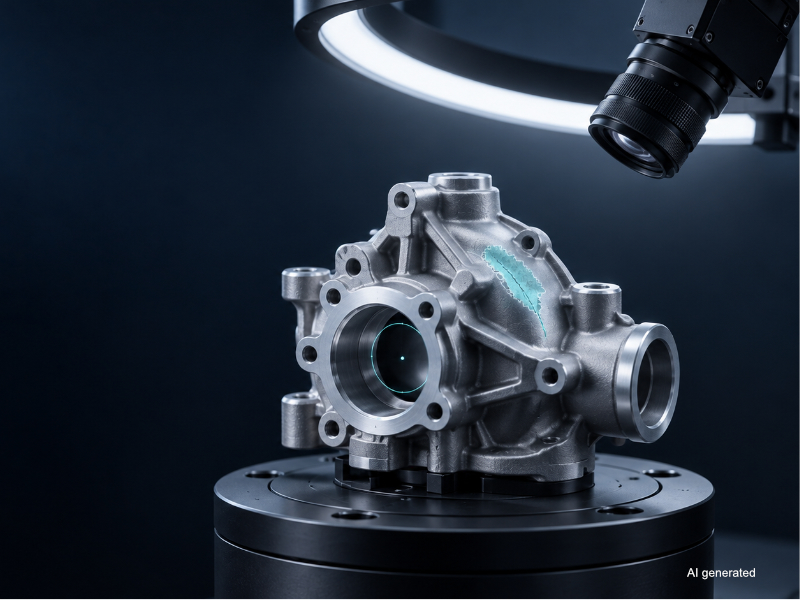
AI-supported machine vision opens up inspection tasks where defects, products, or variants are visually recognizable, but difficult to describe using fixed rules. Deep learning models learn relevant features from image data and can classify, localize, or precisely segment objects down to the pixel level. This makes them particularly powerful when dealing with highly variable surfaces, natural products, and non-specific defect patterns.
In industrial practice, however, the model alone does not determine reliability. Optics, lighting, resolution, perspective, training data, cycle time, and integration into the production process form an overall system. That is why at phil-vision we do not pursue "AI at all costs," but rather select the technically and economically most sensible method for each inspection step. This is frequently a hybrid solution combining deep learning and classical machine vision.
What does AI mean in industrial machine vision?
Artificial intelligence is the umbrella term for systems that solve tasks otherwise requiring human perception. Machine learning learns correlations from sample data rather than rigid rules, while deep learning utilizes multi-layer neural networks that largely learn image features on their own. In a machine vision system, a trained model evaluates the camera image and delivers a class, a position, a defect region, or an anomaly score depending on the task; the result then triggers an industrial action such as ejecting, gripping, correcting, or documenting. The distinction from generative AI is important: generative AI creates new content, whereas industrial AI machine vision analyzes defined image data under controlled conditions and must make reproducible decisions within specified cycle times.
Which deep learning methods do we use for machine vision?
Image classification assigns a complete image or a previously cropped image area to a class – typically used for product variants, defect types, degrees of ripeness, or states.
Object detection recognizes and localizes multiple objects in an image, usually via bounding boxes and class labels. The result can be passed on to classical algorithms, 3D evaluation, or robot control.
Semantic and instance segmentation assigns every relevant pixel to a class, thereby capturing scratches, contamination, or material deviations with surface-area precision. Instance segmentation additionally separates individual objects of the same class, which is particularly important when they touch or overlap.
Anomaly detection learns predominantly from error-free examples what the normal state looks like and highlights deviations. This is helpful when defect types are numerous, rare, or not fully known in advance. An anomaly score is not yet a technical defect decision; thresholds and rules must be validated against real production data. Modern approaches also detect logical anomalies within the image context alongside structural deviations, such as a missing or swapped part.
Deep OCR localizes and reads hard-to-recognize characters, even with changing fonts, polarity, or print quality. For traceability, we combine the result with classical plausibility checks, format rules, and check digits when required.
Deep learning-based edge and feature recognition localizes structures that cannot be stably separated from the background using fixed filters. Precise measurement is subsequently usually performed classically on the calibrated original image. The AI handles robust localization, while geometric methods provide traceable measured values.
Where does AI show its strengths?
Deep learning is particularly interesting when relevant differences exist but cannot be sensibly formulated as a rigid set of rules:
- Surface inspection: scratches, cracks, dents, contamination, irregular structures
- Sorting and classification: highly variable natural products, food, bulk materials
- Completeness check: missing, incorrect or swapped components
- Object localization: variably arranged or overlapping objects
- Identification and OCR: hard-to-read labels, variable fonts
- Process monitoring: complex states or unusual sequences
- Robotics and 3D vision: learned object recognition combined with calibration and grip point determination
A practical example: In automated tool recognition, deep learning localizes and classifies tool types and features such as cooling channels, while classical calibration and stereo reconstruction determine geometry and dimensions. It is precisely this interplay that turns recognition into a robust automation solution.
Good AI doesn't start with training, but with image acquisition
A model can only evaluate information that is contained in the image. What is lost due to unsuitable lighting, insufficient resolution, motion blur, or missing perspective cannot be reliably recovered by any larger network.
Lighting makes features visible. Material and defects determine how light is reflected, scattered, or absorbed. The three most important principles:
- Dark field / grazing light highlights scratches and edges on smooth surfaces.
- Diffuse light (dome, flat) reduces reflections on curved, shiny objects.
- Backlight creates clear silhouettes for contour and dimension checks.
The decisive factor is not the visually most appealing image, but stable feature contrast and reproducible conditions across all permitted variants. Read more about lighting concepts and image quality: AI in machine vision – why image quality is crucial.
Resolution, field of view, and perspective. The ratio between the smallest relevant feature and the inspection area determines sensor resolution, optics, and often the number of cameras. A large field of view with very small defects cannot simply be covered by a single camera – multi-camera systems or moving shots are often more robust in such cases. Surface geometry also matters: steps and curvatures affect depth of field and occlusion. This is why cameras, lenses, lighting, and mechanics are designed together long before the first training data is collected.
Training data: Pure quantity is not the only thing that matters
“More data is always better” falls short – an industrial dataset must represent the real-world task, including permissible variance and difficult edge cases:
- different batches, materials, and suppliers
- shift, tool, and machine conditions
- permitted positional, color, and surface variants
- environmental and aging influences
- rare defects as well as visually similar pseudo-defects
Incorrect labels and unclear quality definitions directly limit model quality, which is why we work with the customer to define what good, bad, and allowable deviation mean. Training, validation, and test data are strictly separated: nearly identical images of the same object must not be distributed across multiple subsets, otherwise the result will appear overly optimistic. Pre-trained models, transfer learning, and synthetic data speed up the setup, but they do not replace testing on real images from the specific system.
How do we evaluate the reliability of an AI inspection system?
A single metric like “99% accuracy” tells you little in quality control. With imbalanced classes, a system can achieve this value while still missing important defects. What matters are the consequences of the decision:
- False negative / escape: A defective part is evaluated as good.
- False positive / pseudo-error: A good part is incorrectly rejected.
- Precision: The proportion of parts identified as defective that are actually defective.
- Recall: The proportion of actually defective parts that are detected.
- Confusion matrix: Which classes or states are being confused?
- Localization/Segmentation: Is the relevant defect area also correctly identified?
Thresholds are both a technical and economic decision, tailored to safety requirements, acceptable escape rates, and pseudo-error rates. In the case of uncertain results, an additional inspection rule or manual review is often more sensible than a forced pass/fail decision. Before serial release, we test the overall system over representative production periods; afterward, versioned datasets, documented release criteria, and a defined retraining process ensure long-term maintainability.
Where classical machine vision is superior
Rule-based machine vision remains the most efficient and transparent solution for many tasks: If a feature can be clearly described geometrically or photometrically, classical methods often deliver deterministic, easily understandable results much faster – completely without training data. Typical examples:
- Calibrated dimensional and position inspections
- Precise edge, circle, and contour determination
- Presence checks under stable contrasts
- Barcode and data matrix reading under defined conditions
- Template matching and position determination
- Filters, morphology, and threshold methods
The common statement "AI cannot measure" also requires clarification: A neural network can estimate sizes, but for calibrated, repeatable measurements, classical geometric analysis generally remains the more reliable choice. Read more about where AI reaches its limits: Why AI is not enough in machine vision.
Hybrid vision: Systematically combining deep learning and classical machine vision
The question is not "AI or classical machine vision?", but rather: Which method solves which sub-step most robustly?
- Classical pre-processing corrects distortion, normalizes the image, or limits the inspection area.
- A deep learning model localizes a variable object or segments a defect that is difficult to describe.
- Classical geometry measures edges, distances, areas, or 3D coordinates within the found region.
- Plausibility rules check tolerances, quantities, sequences, and process knowledge.
- PLC or robot communication deterministically transfers the result into the production workflow.
This division of tasks leverages the generalization capability of deep learning where variability dominates, while measurement, logic, and interfaces remain transparent and validatable. Hybrid systems often require less training data, reduce false alarms, and are easier to maintain than a monolithic end-to-end solution.
How a robust AI machine vision solution is created
1. Define inspection goal and decision criteria
We clarify defect catalogs, tolerances, cycle times, interfaces, installation space, and the economic consequences of slippage and pseudo-defects.
2. Examine feasibility with real parts
In a feasibility study, we compare camera, optics, and lighting concepts and check whether the crucial features can be made stably visible.
3. Define data strategy and algorithm
We determine which variants are required, how data is captured and labeled, and whether classification, detection, segmentation, anomaly detection, classical machine vision, or a combination is suitable.
4. Validate model and overall system
We evaluate not only model metrics, but also image acquisition, cycle time, computing platform, edge cases, and behavior under real production conditions.
5. Integrate, monitor, and further develop
Camera, lighting, software, PLC or robot, and user interface are combined into a maintainable overall system. Production data and changes are controlled and incorporated into further optimization.
Why phil-vision?
For us, AI machine vision is not an isolated software topic, but rather a building block alongside optics, lighting, calibration, and industrial integration. It is precisely this interplay that determines whether a deep learning model looks good in the lab or runs reliably in shift operation. We therefore choose openly between AI, classical machine vision, and hybrid approaches and accompany projects from the initial feasibility analysis to the production-ready system. You can find an overview of our entire range of solutions on our solutions page.
Conclusion: The best industrial AI solution is usually hybrid
Deep learning expands industrial machine vision with powerful tools for variable objects, complex defect patterns, and features that are difficult to translate into fixed rules. However, it neither replaces physically clean image capture nor the strengths of classical methods.
Our experience shows: Particularly robust and economical systems are usually created when AI and traditional machine vision work together in a targeted manner. The AI recognizes and localizes complex patterns. Classical algorithms measure, calibrate, and inspect clearly defined rules. Optics and lighting ensure that both methods receive reliable information. It is precisely this hybrid approach that creates traceable inspection decisions and stable results in everyday industrial life.
Would you like to know which approach suits your task? We examine your objects and image data, evaluate technical feasibility, and develop a suitable inspection concept – classic, AI-based, or hybrid.