

AI in machine vision
Despite all progress, an old principle still applies: Garbage in, garbage out. An AI model can only be as good as the image data it receives.
This inevitably raises the question:
How do I optimize my image acquisition to create the foundation for stable and reliable results in the first place?
The foundation: Lighting, optics, and camera as a complete system
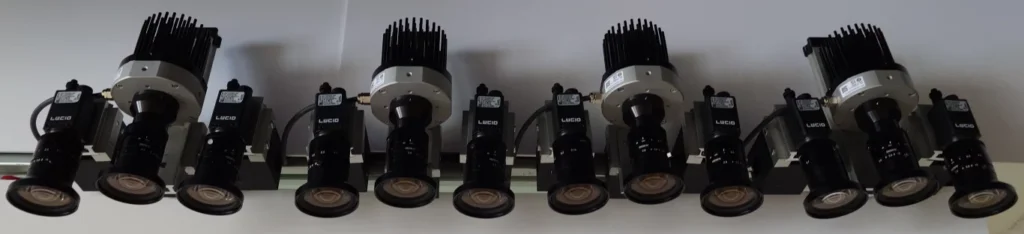
The decisive factor is always the selection and interplay of the components. Lighting, optics, and camera cannot be viewed independently of one another.
At the beginning, we therefore ask a few fundamental questions:
- How do the features relevant to the inspection manifest themselves, and how large are they?
- How are these features spatially distributed?
- What optical properties do the features and substrate material have, for example, glossy, matte, transparent, or diffusely reflective?
- Is there only one type of feature or multiple types?
- Is the substrate material homogeneous, or does it vary significantly, perhaps even from one capture to the next?
The answers to these questions set the framework for every subsequent technical decision.
Focus of this article: Feature size and local resolution
In this first article of the series, we deliberately focus on one aspect:
The size of the relevant features and their impact on resolution, optics, and camera selection.
The feature size determines the required local resolution and, consequently, directly dictates the camera and lens setup.
Focal length, magnification, and working distance are not secondary decisions, but rather key levers in system design.
Why resolution is not just a camera specification
Practical example: Detection of small scratches
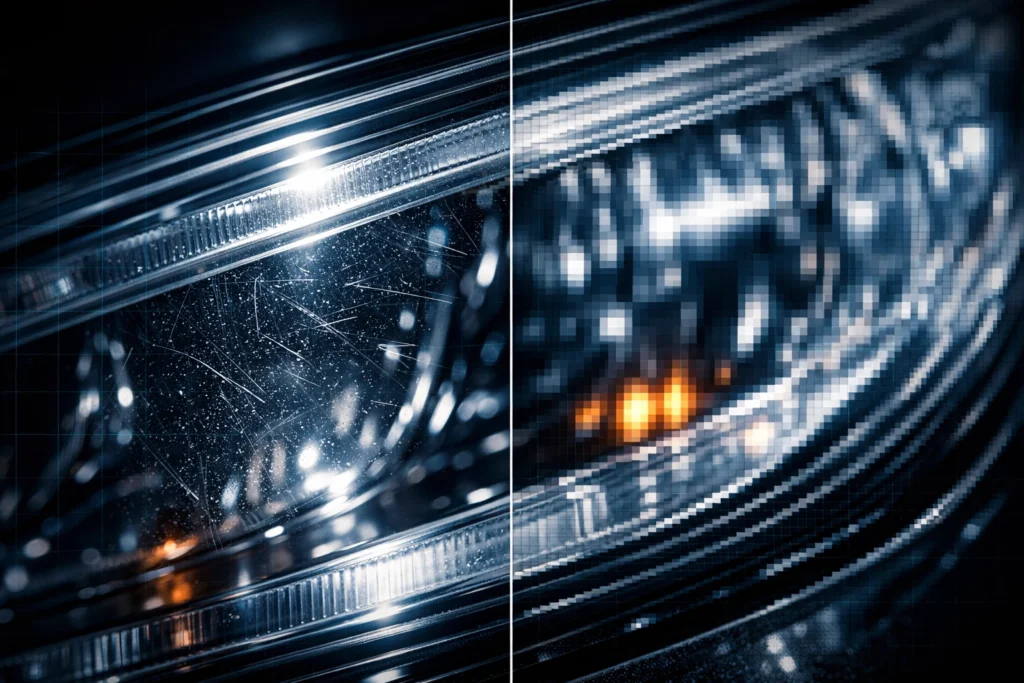
If small scratches with a minimum width of about 10 µm need to be detected on a car's headlamp, it will not be possible to inspect the entire headlamp reliably with a single 5-megapixel image.
A simple rule of thumb applies to robust solutions:
Depending on the feature characteristics, at least two to three pixels should cover the smallest relevant structure.
In the example mentioned, this corresponds to an object resolution of approximately 3.3 µm per pixel.
Depending on the component size and cycle time, this suggests a line-scan setup or a tiling/multi-image strategy rather than a traditional single-shot capture.
Outlook: Additional parameters for robust AI machine vision
This leaves several exciting levers open for the upcoming articles in this series:
- Distribution and contrast of the features
- Optical properties of the feature and substrate material
- Handling inhomogeneous or changing surfaces
It is precisely at these points that it is often decided in practice whether an AI model works "somehow" or whether it runs stably and reliably in the long term.