
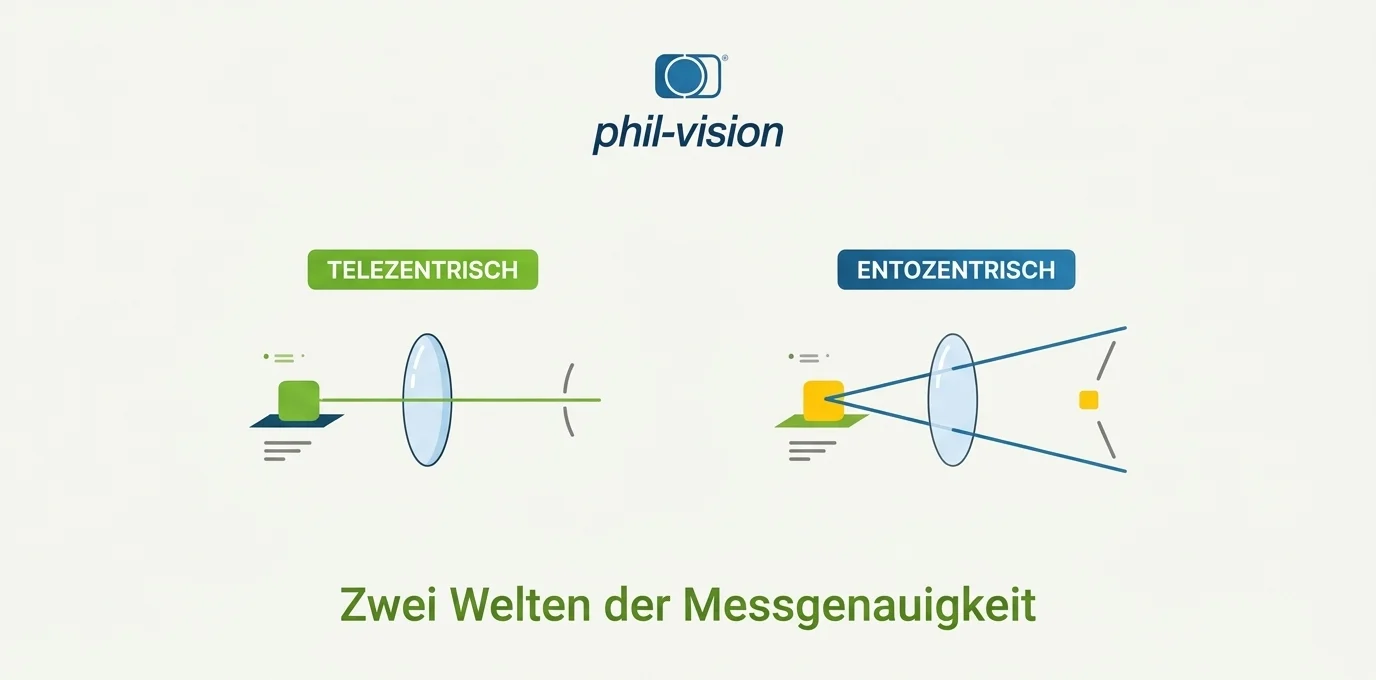
Precise results are the alpha and omega of any optical measurement task. There are various ways to achieve them. In imaging metrology, telecentric lenses are frequently used for high-precision measurements.
We would like to explain here why this is the case and what options are available even without telecentric optics. To do this, we must first explain the special properties of telecentric optics.
Telecentric imaging
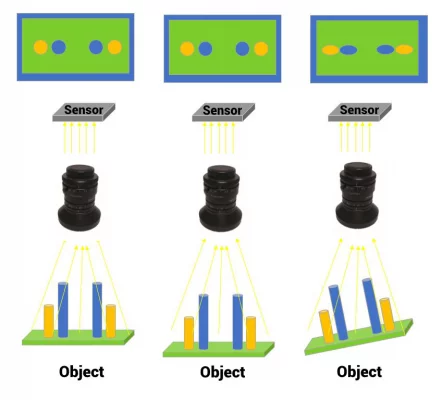
With telecentric optics, the light rays run parallel to the optical axis, the image shows no perspective distortions, and distances in the image can be measured without errors. The light is directed as if one were viewing the image vertically from above, everywhere from the center to the edge.
The magnification in the axial direction (Z-direction to/from the edge) within a defined range is equal, meaning the distances measured in the image do not change if the object is slightly closer to or further away from the camera.
This means that if a distance between two drill holes is measured precisely, the measured distance remains exactly the same even if the object moves, or if the measurement object approaches or moves away from the camera.
However, this is not a "blank check," because the image can still become blurred if the object lies outside the ideal object plane.
In principle, even blurred contrasts can still be measured "subpixel-accurately", although overall accuracy decreases.
However, these good properties of telecentric optics come at a price. To achieve a parallel optical path, the front lens must be at least as large as the object to be imaged. For smaller fields of view, costs do not play a very large role, but for fields of view > 5 cm, the lenses quickly become expensive. In addition, they are very heavy, a major disadvantage if they have to be transported on a robot, for example.
In our calculators, we have therefore limited the width of the field of view to 150 mm. Of course, there are also lenses with significantly larger image fields, but the costs for these are in the 5- to 6-figure range.
What accuracies are possible with entocentricity?
Of course, given certain conditions, it is also possible to perform cost-effective measurements on large fields of view using classic entocentric lenses.
Entocentric lenses depict in perspective, meaning that the image size changes depending on the working distance. Objects farther away are therefore imaged smaller in the image plane compared to equally sized objects that are closer to the camera. In addition, objects located closer to the optical center (and thus also closer to the camera) are imaged larger than equally sized objects at the edge of the image.
Actually, with entocentric optics, accurate measurements are really only possible in the center. However, the "distortion" from the center to the edge is known for these lenses. If this could be calculated for every pixel in the image, precise measurement would be possible. Furthermore, the distance to the object behaves simply like a "magnification factor," which is also known for a given lens. So let's take our example with the two drilled holes. If the distance from the object to the camera and the distortion are known, the distance could also be measured using affordable entocentric optics.
How does that work? Quite simply – we calibrate!
During calibration, the "distortion matrix" of the optics and the tilt of the optics relative to the image sensor are measured using a suitable object. This process also accounts for any inaccuracies and optical aberrations of a lens, such as a slight tilt relative to the image axis. Using this "distortion matrix" or a correction model, all pixels in the image are corrected via software, and an "ideal" image is calculated. This part of the calibration is called "intrinsic" (internal) calibration.
To calculate the "magnification factor," but also to correct any potential tilt of the camera relative to the measurement axis, an additional "extrinsic" (external) calibration is performed. However, this requires establishing a fixed measurement plane.
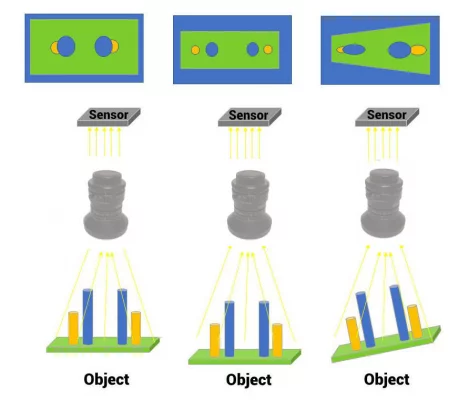
The measurement result now depends on how precise the specified object distance to the camera and the measurement plane is. An estimation is not sufficient here. However, if a plane can be precisely defined and an object can be precisely positioned on this plane repeatedly, then all edges within this single measurement plane can be measured just as well as with telecentric optics. Furthermore, the same mathematics can be used to transform the measurement to another plane. If the measurement object features areas with different heights that are precisely known relative to each other and to the measurement plane, areas of varying heights can also be measured just as accurately as with telecentric optics.
One disadvantage of entocentric optics is that they do not "see" perpendicularly onto the image plane everywhere. As a result, taller objects—or even objects of the same height located closer to the center of the image—can "shadow or overshadow" parts of the image at the edges. The peripheral areas simply disappear behind the object in the center of the image, go undetected, and cannot be measured. This happens very quickly, especially with lenses that need to cover a wide angle and/or when an object has areas of varying heights. Therefore, when using entocentric lenses, you should stay as far away from the object as possible and use long, so-called "telephoto" focal lengths.
Use of entocentric lenses with transmitted light illumination
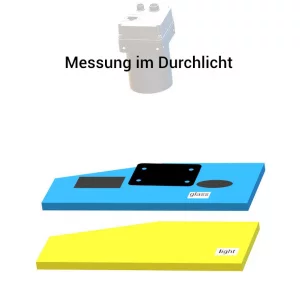
Ein Spezialfall bei der Verwendung von entozentrischen Objektiven ist das „Durchlichtverfahren„. Hier können nur Objekte vermessen werden, die relativ flach sind (< 1 cm Objekthöhe bei 2-4 m Abstand der Kamera), damit das oben genannte „Verschatten“ gering bleibt. Zudem muss die Höhe des Objektes genau bekannt sein. Objekte mit < 1 m Durchmesser können so genau und relativ kostengünstig vermessen werden. Bei Bedarf muss eventuell ein ganzes „Array“ an Kameras aufgebaut werden, um das Objekt zu vermessen.
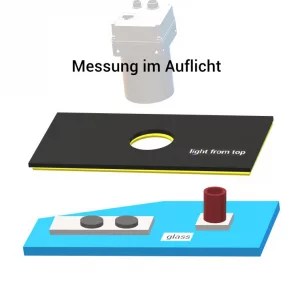
Use of entocentric lenses with reflected light illumination
In conclusion, we would like to point out the issue that when using entocentric lenses for measurements in reflected light, the distance must be known. If measurements are truly required at every location, the system can be expanded by using a second, likewise calibrated camera that views the same area. Such a system is called a "stereo system." In this case, you work in 3D on a point cloud and can measure at any location in the image.
In our calculators, 3D metrology is divided into two variants: a "stereo system" and a "triangulation system," which use different methods to calculate the point cloud.
CONCLUSION:
At the beginning, we asked whether precise optical measurement is only possible with telecentricity and the relatively high costs associated with it. In summary, we can state that for small fields of view, the advantages of telecentric measurement outweigh the drawbacks. For larger fields of view, one should consider whether feature distances are known or can be determined using suitable measuring tools. If so, entocentric measurement is often accurate enough, and at a fraction of the cost.