
Inspection table for measuring plant parts for a gene bank
Our customer, the Leibniz Institute of Plant Genetics and Crop Plant Research (IPK), has been involved in the image acquisition and measurement of plants/plant parts, fruits, and seeds since the mid-1990s.
The IPK was looking for a system to simplify the documentation and description of accessions for the GBIS gene bank information system.
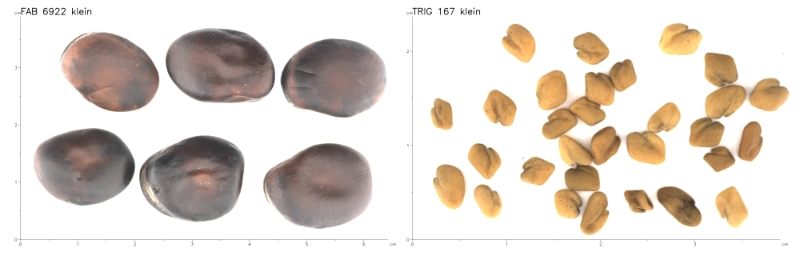
But what actually is an accession?
An accession (also referred to as a sample) refers to a specific collection of plants, animals, or microorganisms kept in a gene bank. Each accession represents a specific genetic variant or variety, identified by unique characteristics such as a registration number, a name, or geographic information.
Accessions are kept in gene banks to preserve the genetic diversity of plants, animals, or microorganisms. This is important because many plant and animal species are threatened by environmental changes, shifts in land use, and other human activities. By collecting and preserving genetic resources, researchers can access important genetic traits now and in the future to breed new crop varieties, combat diseases, or address other challenges.
Source: https://www.pflanzenforschung.de/de/pflanzenwissen/lexikon-a-z/akzession
Design of the Measurement and Archiving System
Based on a 2.4 MP color camera and four pvLight illumination panels, a customized system was developed to capture and measure plant parts, as well as name and archive the corresponding images. The field of view can be adjusted from approx. 28×45 mm to 320×400 mm. The images are then saved along with the measurement values, uploaded to GBIS, and made available to users and the public via the internet.
To ensure dimensional accuracy despite any variations between the camera and the object, phil-vision developed a dedicated calibration target specifically for this application. The target must be positioned at the exact height where the measurements will later take place. This allows the operator to display a true-to-scale grid in the image and freely draw rulers between two points.
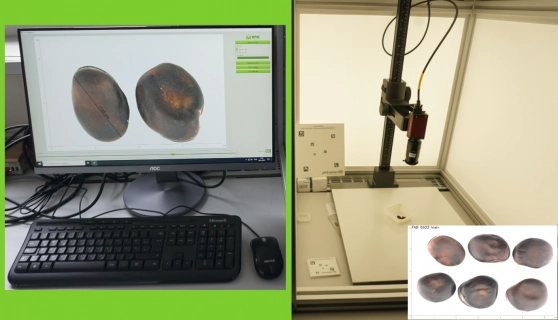
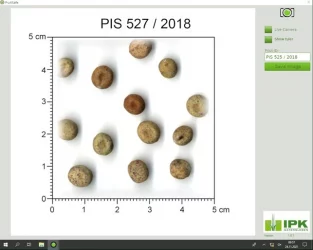
A live image is displayed in the user interface. By clicking a button, a still image can be captured (or you can switch back to the live image).
The interface consists of a large image window and a control panel on the right-hand side. A slider provides an easy way to adjust the image brightness. An input window/text field allows users to enter a string of characters, which is also displayed in the image. This identifier is further used as the filename when saving the image.
Why phil-vision?
Matthias Kotter, Project Manager at IPK Gatersleben: “We were looking for a successor to the Leica system we had been using and didn't find any standard systems during our internet research. Through this search, we came across phil-vision. The system integrator put together an individual system for us, handled the software programming, and then carried out necessary adjustments via remote connection. The most important thing for us was that the system delivered a good image with measurement capabilities. This is ensured by the robust LED light panels, which provide extremely homogeneous illumination and enable top-quality images.”
Future Possibilities

Gregor Philipiak, responsible for the project at phil-vision, envisions expanding the system with an AI component in the future and, in a next step, enabling artificial intelligence-supported classification of plant parts.
Leibniz Institute of Plant Genetics and Crop Plant Research (IPK)
The IPK conducts both basic and applied research in the fields of resource research, genomics, and molecular plant physiology.
Research is conducted in four scientific departments (Gene Bank, Breeding Research, Molecular Genetics, and Physiology and Cell Biology). The Gene Bank department is one of approximately 1,400 public seed banks operating worldwide. With more than 150,000 seed samples from about 700 genera, it is one of the leading institutions for the preservation of old crops and their wild relatives.