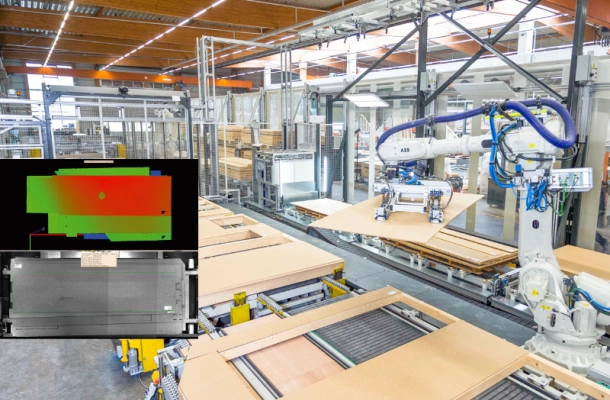
The future builds on wood – sustainable and energy-efficient. Ultra-modern prefabricated houses, such as those from manufacturer FingerHaus in Frankenberg (Eder), are on the rise. Demand is high in an industry that is booming while also being affected by a shortage of skilled workers. Existing employees are to be relieved as much as possible and deployed exclusively for demanding tasks, while maximum quality through high process reliability remains the focus. To address these challenges, BETH Sondermaschinen GmbH has developed and implemented a comprehensive plant concept that includes both the semi-automated production of timber frameworks and the automated paneling of wall elements. 3D camera systems from phil-vision are used for this purpose. The core element of the system is the robot cell for the automated paneling of wall elements. Previously, wall elements made of gypsum plasterboard and wood-based panels were paneled by employees on assembly tables in the production line, followed by fastening using hand-held staplers.
(c) Beth Sondermaschinen GmbH
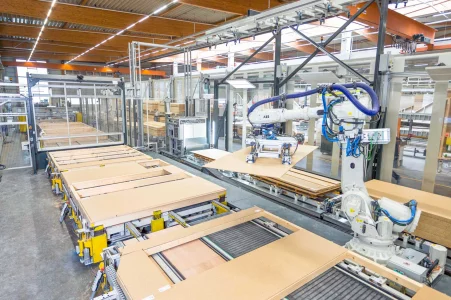
The wall elements were then transferred to a buffer system. In the future, a 50-meter-long system with a width of approx. 10 meters will offer maximum flexibility when sheeting with standard dimensions and special geometries, including feeding and transfer to the next production step. Automated sheeting is possible with panel geometries from 80x250mm to 1250x3000mm. The various panel parts are provided in stacks, with the parts for a single wall element forming a coherent stack. A robot with a vacuum gripper system picks up the panel parts and precisely positions them on the timber frame, while the integrated 3D camera system handles the identification of the panel parts. The automatic fastening of the two different panel types is carried out by the robot using a stapler.
State-of-the-art camera system and intelligent lighting system for detecting panel position and alignment
In close consultation with the customer, phil-vision developed a core element of the system: a state-of-the-art machine vision system based on 3D cameras for recognizing the cut panel components, including recognition software and integration into the overall system. The 3D camera systems detect the respective position of the wood-based or gypsum plasterboard panels, and an intelligent lighting system supports this position detection . The precise position data is immediately processed by software developed by BETH and transferred to the robot, which then performs the precise paneling.
The system used consists of eight 20MP monochrome cameras with a GigE Vision interface, matching compact lenses, and two pattern projectors mounted above the sheeting station. The cameras form four stereo systems in total, which generate a complete point cloud with just a single capture. Subsequent processing is carried out on a high-performance industrial PC. The customer-developed software solution "PK Construct" ensures fast and reliable communication between the camera system and the robot.
(c) Beth Sondermaschinen GmbH
Every prefabricated house is one of a kind
The challenge for the system is the complexity of the wall elements, as every prefabricated house is unique in its own way, tailored to the customer's specific wishes. Alongside standard wall elements, there are repeatedly special cases with varying geometries.
- Wall length: 800 – 12000 mm, tolerance +/- 10mm
- Wall height: 1600 – 3000 mm, tolerance +/- 5mm
- Wall thickness: 80 – 300 mm, tolerance +/- 2mm
The dimensional stability of the materials also fluctuates within a range of +/- 3mm.
The panel parts of a wall element are held together in a stack of up to 70 layers, with multiple parts able to lie in a single stack layer. These are not arranged in a fixed order, meaning that continuous processing from left to right across the wall element is not possible; instead, the individual panel parts must be placed at their respective distinct positions on the wall element.
Naturally, the individual panel parts must not be damaged during the transport and positioning process. Dimensional tolerances must be taken into account. In terms of design, a 3mm gap is provided between the individual panel parts of a sheeting system, which can be used to compensate for tolerances.
Precise positioning using 3D camera technology
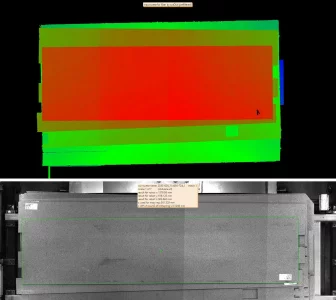
Exact positioning of the individual panels is essential, as faulty sheeting leads to a standstill of the entire production process. To determine the exact position of the panel parts for the gripper system, the parts are measured using 3D camera systems, and the data obtained yields the absolute position within the robot cell's coordinate system.
When asked about the main challenges facing the machine vision system Patrick Gailer, Managing Director of phil-vision, responds: “The sheer size of the system , which is necessary due to the large measurement volume , presents a major challenge for the calibration , which, with temperature correction, requires only a few recalibrations per year. Furthermore, it is difficult to achieve a highly precise position while simultaneously having to react flexibly to components that, due to production processes, exhibit significant variations compared to the models and can be bent by up to three times their height.”
An additional goal during system development was to provide a system that is significantly more affordable than other high-precision 3D scanners currently available on the market.
The system we developed differs significantly from other systems that were tested. The combination of a short cycle time of 8 seconds, a large measurement volume of 4.1m³, and an accuracy well below 1mm is likely unique on the market. Because image capture takes place while the robot is still placing the previously measured panel, very high cycle times are possible. This has now proven itself in series production for over half a year."
State-of-the-art automation
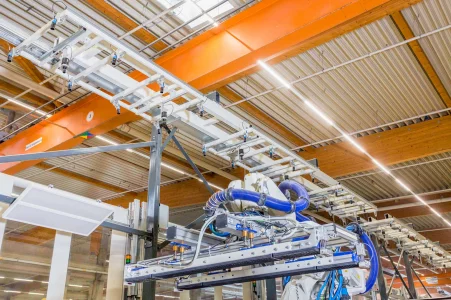
Handling and stapling of the panels onto the timber framework within the sheeting cell is performed by an ABB industrial robot, type IRB 6700, mounted on a travel axis over 20 meters long. The robot is equipped with a SCHUNK tool changer system to automatically switch between the suction gripper for picking up the panels and the stapler.
After the panels have been placed in the correct position on the timber framework manufactured in the previous cell, they are fastened with staples according to the customer's design specifications. The calculation of the optimal paths is once again handled by the BETH software "PK Construct".
Ergonomics, process reliability, and flexibility in a single system
The result of the BETH Sondermaschinen GmbH project is a highly precise sheeting machine that also enables efficient collaboration between employees and robots thanks to intelligently designed safety zones. A central, user-friendly cell control system allows individual processes to be managed for maximum flexibility during any intermediate work steps.
Particular emphasis should be placed on the small yet crucial details of this system, which were only made possible through close collaboration with the FingerHaus employees: existing work processes were analyzed, improvements identified, and a tailored automation solution developed. Whether it is the efficient use of available production space, the operability of the robot in individual processes for more flexible cooperation with the machine operators, or simply the fact that process reliability is enhanced – with this system, FingerHaus production is at the cutting edge of technology and ideally equipped for the future.
Friedrich Köster, Managing Director of BETH Sondermaschinen GmbH, summarizes the collaboration with phil-vision on this project as follows:
"Due to the critical importance of machine vision for the functionality of the overall system, we were looking for a high-performing partner in this field, and we found that partner in phil-vision. The experienced experts provided us with exceptional advice regarding the feasibility of our idea, conducted extensive tests for us, and put together the optimal camera technology that proves its worth day in and day out in practical use at our customer FingerHaus."
A video of the application and further detailed information can be found on our customer's website
More interesting application reports
Automated tool recognition and measurement based on AI and 3D machine vision
High-precision hole detection in steel strips with machine vision
Visual inspection of cooling boxes for the pharmaceutical and food ndustriy
Seal inspection of food packaging
Perfect printed coins thanks to machine vision
Perfect fold quality through machine vision
High-speed video recordings:
Optical measurement and inspection of rubber seals
Machine vision keeps the high-rack warehouse organized
Bird-tracking System for wind turbines