Magazines, books, or brochures have a handy format, but they are printed on large sheets, approximately A0 format. These sheets are folded, cut, and bound in folding machines. In this application report, we look at a small but very important detail of these machines, where machine vision from phil-vision helps to avoid errors and waste.
Even today, folding machines operate autonomously, with a robot taking on the physically demanding task of stacking the folded sheets. However, what was previously missing for a fully automated processing workflow was independent fold quality control, because paper is difficult to handle, and even the best folding machine cannot prevent individual sheets from being folded inaccurately. However, an inaccurately folded sheet leads to individual pages being trimmed crookedly, which is unacceptable to the customer.
How theseprocesses could be automated in the future and howemployees could be relieved was the challenge facing MBO Postpress Solutions GmbH, a leading manufacturer of folding machines. Since the company does not employ machine vision specialists, they brought on board phil-vision GmbH, an experienced system integrator. Following initial discussions about the task, an intensive planning phase began, and in close collaboration, MBO Postpress Solutions GmbH and phil-vision developed theVT50 optical fold quality control system, which is arguably unique on the market.
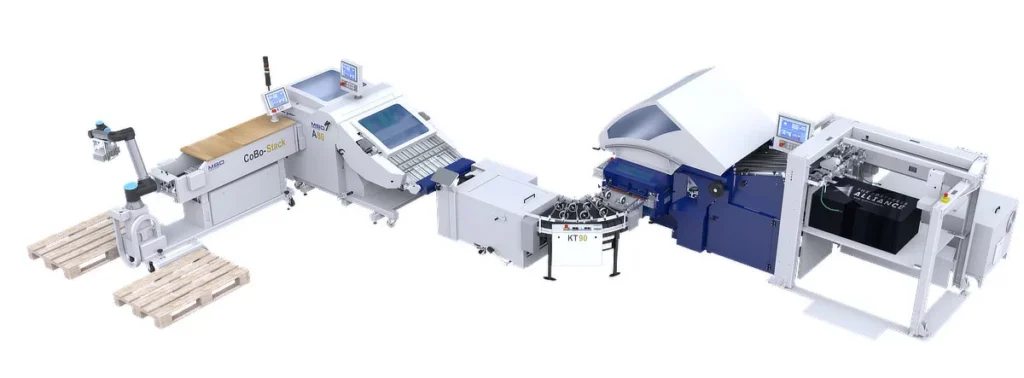
Image of the complete system. The VT50 is an important component of the autonomous production of print products.
High-quality and error-free folding
Large printed paper sheets are processed by the folding machine and folded in such a way that the pages of the final product lie precisely on top of each other in the correct order. The inspection system ensures that the multi-folded printed sheets produced by the upstream folding machine exhibit consistently objective fold accuracy. To achieve this, the distances between the crop marks and the rear and side sheet edges are measured on both sides of the folded sheets . Even a single faulty fold in the sheet affects the measured distances and is detected.
If a sheet falls outside the preset tolerance, it is rejected during ongoing production. The accepted tolerances can be defined in 5 different, adjustable quality levels. If several consecutive sheets are defective, the production system shuts down, and the operator makes the necessary adjustments to the folding machine. However, the operator only needs to pay attention to the folding machine if the VT50 has detected a persistent issue with the fold quality, freeing up time for other tasks.
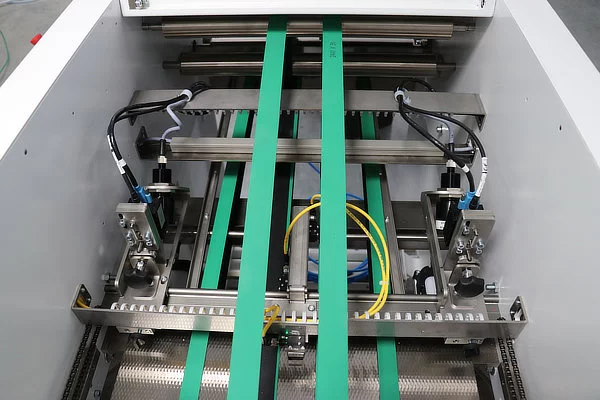
Two cameras inspect the quality of the folded sheets under controlled lighting conditions.
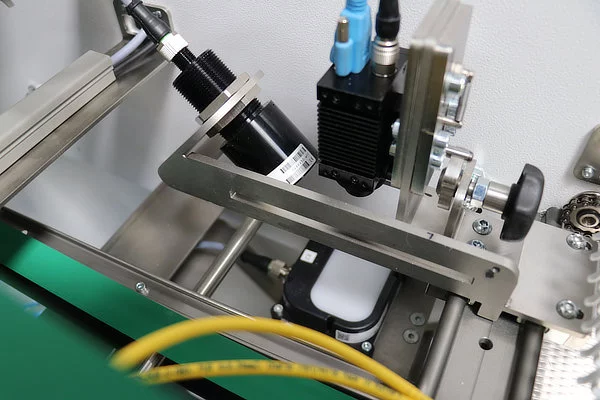
Two cameras measure the crop mark position relative to the outer edge of the paper.
Intensive collaboration as the key to success
It was a fairly long road to a satisfactorily operating system, involving a multitude of changes and adjustments. Since MBO had no in-house machine vision specialists, phil-vision took over the entire project engineering. This ranged from feasibility studies and component selection to programming support and assistance with PLC integration.
A key challenge for the machine vision system The challenge was the high speed at which measurements had to be taken. The sheets of paper move at speeds of up to 180 m/min and cannot be stopped for measurement. In addition, there is a cycle time of approximately 0.1 seconds . At the same time, cost-effectiveness had to be maintained. The final system is based on two highly sensitive color cameras that, under controlled lighting conditions with specially coordinated incident and backlighting, check the quality of the folded sheets.
The system was first introduced in June 2021 during the Postpress Alliance "Cutting and Folding" themed days and has since proven itself in practical application.
Peter Steinbrück, Project Manager in charge at phil-vision, on the challenges of the project:
"During the project, there were numerous changes such as different shapes and arrangements of the marks, enlargement of the field of view, or disruptive elements in the image. The original project plan did not account for color control marks on the edges, smeared crop marks, and partially visible page content, but ultimately these were not allowed to affect the evaluation. The close and focused cooperation between the development teams at phil-vision and MBO was the key to an optimal solution. Communication was very open from the very beginning. Therefore, the software was designed so that the evaluation strategy could be adjusted quickly and with minimal effort. Due to the high cycle rate of the system, the total processing time per sheet is limited to 40 ms. By choosing very simple yet high-performance machine vision tools, this requirement was easily met."
Sebastian König, Head of Development at MBO, summarizes the collaboration with phil-vision:
"The collaboration was very professional. Great importance was placed on precision and detail in every project phase. The fast response times, project management, and overall high level of competence were also very positive."
Video of the application
More interesting application reports
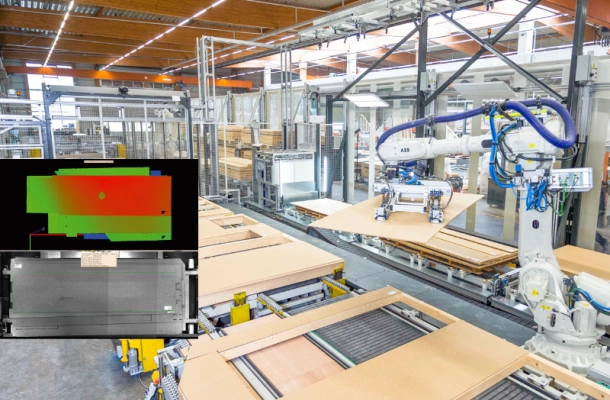
Automated wall production for prefabricated houses
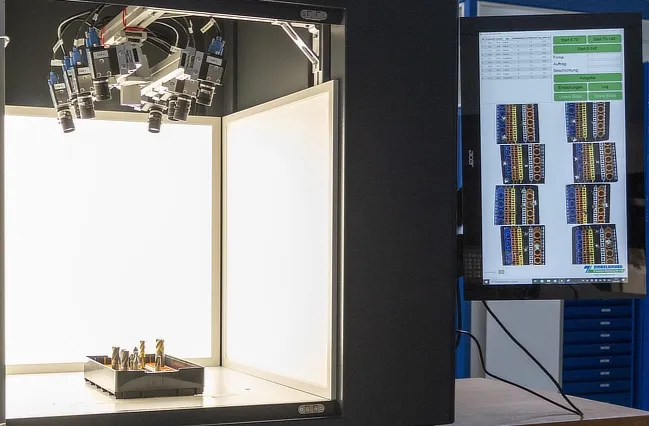
Automated tool recognition and measurement based on AI and 3D machine vision
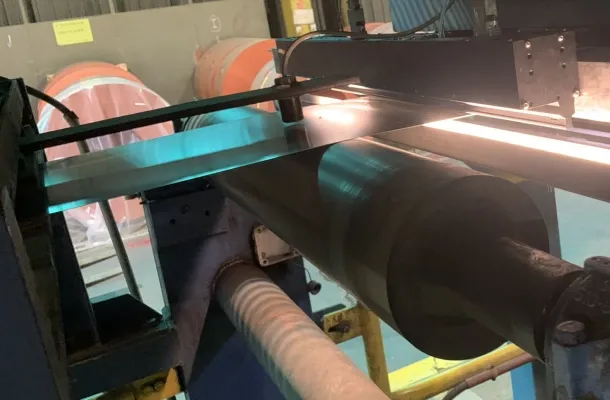
High-precision hole detection in steel strips with machine vision
Visual inspection of cooling boxes for the pharmaceutical and food ndustriy
Seal inspection of food packaging
Perfect printed coins thanks to machine vision
High-speed video recordings:
Optical measurement and inspection of rubber seals
Machine vision keeps the high-rack warehouse organized
Bird-tracking System for wind turbines