
Demanding machine vision tasks require high-performance components and many years of know-how to create perfect solutions for the user. To ensure this, customers have successfully used machine vision products from Teledyne DALSA for a wide variety of applications for years.
In addition to high-performance products, another point is enormously important to us and our customers: in the event of an error or if questions arise, the manufacturer's support must be fast and competent and provide reliable answers—something we have been able to rely on with Teledyne DALSA for many years.
For demanding image processing solutions, we have long relied on components from Teledyne DALSA. Our specialists develop customized system solutions in close consultation with end users, tailored to their specific requirements. The primary focus is always on finding the optimal technical and economic solution to the given task, selecting the best possible combination of components, and integrating the machine vision system into the existing infrastructure in such a way that reliable, uninterrupted operation with error-free results is guaranteed throughout the entire lifecycle, even in applications running 24/7. Teledyne DALSA products have proven themselves exceptionally well in numerous applications in this regard.
In this environment, the Genie camera series from Teledyne DALSA has proven itself exceptionally well. These cameras still deliver high-quality images even at elevated operating temperatures and feature a very low failure rate. In the rare instances where failures did occur due to extreme conditions, Teledyne DALSA was very accommodating and facilitated a quick, unbureaucratic exchange of defective cameras. Another advantage, alongside mechanical robustness, is the numerous variants of the Genie camera series, which offer a suitable model for almost every conceivable application of 2D machine vision in terms of available resolutions and interfaces.
Over the past few years, we have successfully tackled numerous tasks for various applications in the electronics industry. For instance, the production of electronic components involves so-called hot processes, where processes such as wafer deposition take place and the quality of the process must subsequently be verified.
Due to challenging production conditions, only industrial cameras that deliver accurate results even in an increased temperature range are suitable for this purpose.
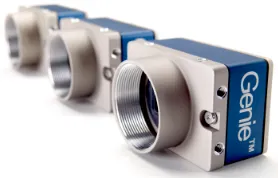
In addition, we frequently use Genie cameras to build multi-stereo systems, as they can be synchronized very easily and precisely via Precision Time Protocol (PTP). Based on this standard, the use of a trigger cable is unnecessary, and synchronization takes place exclusively via the network.
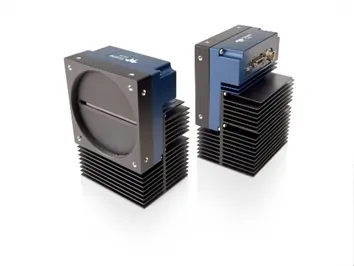
In many applications where web materials need to be inspected, line scan cameras have proven to be a more suitable technology compared to area scan cameras. Image capture is performed line by line. The image strips captured in this way are then assembled into a theoretically endlessly long image, thus enabling, among other things, the inspection of steel coils, paper rolls, or textile webs.
Since Teledyne DALSA has been a technology leader in the development and production of line scan cameras for many years, we regularly rely on their unique portfolio, which covers a wide variety of resolutions, speeds, and interfaces and enables us to select the optimal line scan camera for the most diverse industries and applications.
3D machine vision has advanced significantly in technological terms over recent years and now allows for a much simpler solution to many applications that cannot be realized with 2D systems or can only be achieved with considerable effort. The technology is now cost-effective, reliable, repeatable, easy to implement, and has proven itself in a wide range of demanding applications.
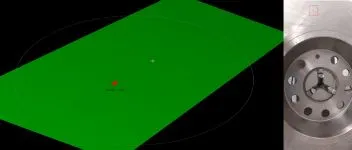
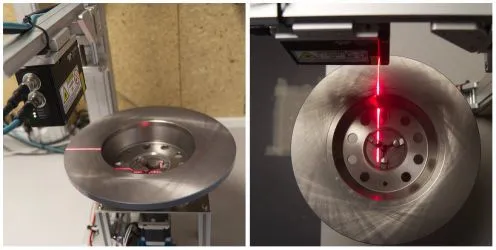
A typical example of a 3D application we have implemented is the optical inspection of brake discs for the automotive industry, which enables better defect matching than 2D machine vision systems.
Since brake discs are manufactured from grey cast iron, they can feature blowholes that are then exposed during grinding. These surface holes must be dimensioned, and the depth of the balancing mill groove must be measured.
However, inspecting brake discs is not straightforward due to the lighting conditions:
The surfaces are polished and exhibit grinding marks that are unavoidable during production and generate specific artifacts.
To make matters worse, fingerprints or fine-grained sand remaining from previous grinding and washing processes are often falsely detected by 2D systems as unacceptable defects.
In numerous applications, using a single camera is not sufficient to check all potential defect characteristics. In such cases, the use of multi-camera systems provides a remedy. With these, two or more cameras inspect the test parts simultaneously from multiple directions and, by comparing the images from all cameras, enable
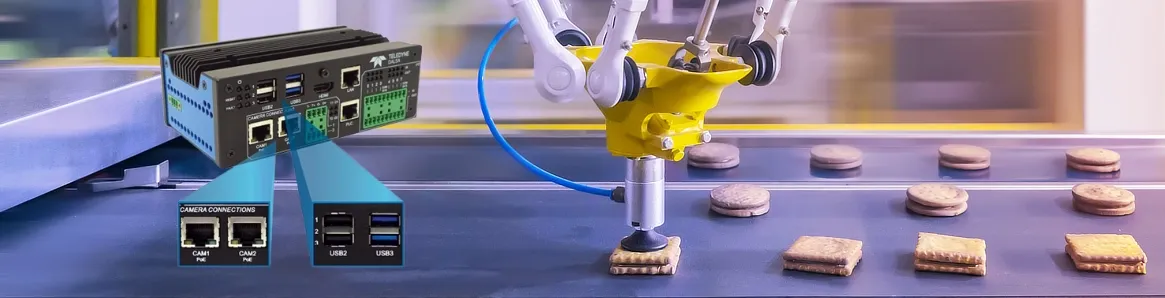
For example, the Vicore dual camera system from Teledyne DALSA enables the combination of a wide variety of 2D and 3D cameras. Using this system, we were able to implement a setup for a major European food manufacturer that checks for the presence of cookies, their correct dimensions, the correct degree of browning, as well as their quantity and distribution on baking lines.
An important criterion for realizing this application was the robustness of the machine vision system and the ability to adapt it precisely to all specifications in order to guarantee trouble-free 24/7 operation.
Teledyne Imaging develops and produces the sensors for its line scan cameras in-house, allowing them to be optimally tailored to customer specifications. In addition, the product portfolio covers the complete spectrum of machine vision. Regardless of whether you need 2D or 3D systems, visible light or other wavelength ranges such as SWIR or UV, or single or multi-camera systems, you will always find a suitable camera for your specific application.
In-house software development ensures seamless adaptation of the required software to the hardware portfolio. With Sherlock, Inspect, and Sapera, several software packages are available that provide users with varying levels of expertise in machine vision with comprehensive options for realizing their solutions. Furthermore, the Astrocyte graphical AI training tool gives users an effective way to simplify the development of machine vision systems using innovative tools from the field of artificial intelligence.
We are happy to provide you a free consultation on any type of inquiry, no matter how unusual it may be.
Call us at +49 89 125094350, or send us your requirements directly by email. Alternatively, you can use the button in the menu bar to book an appointment directly for a free initial consultation.
To provide the best possible experience, we use technologies such as cookies to store and/or access device information. By consenting to these technologies, we may process data such as browsing behavior or unique IDs on this site. Not consenting or withdrawing consent may adversely affect certain features and functions.