
AI is powerful, but not magical
That said: AI can be an extraordinarily powerful tool in industrial machine vision. Particularly for products with high variance, features that are difficult to describe formally, or complex surface structures, it offers possibilities where conventional methods reach their limits. When used correctly, it can significantly improve robustness, flexibility, and recognition performance.
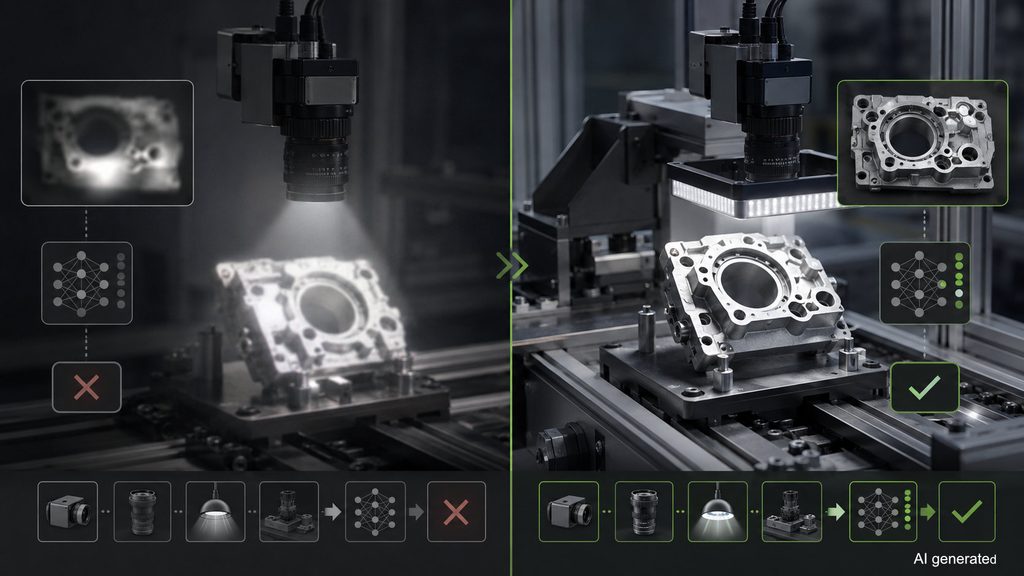
What AI cannot do, however, is compensate for a fundamentally poorly designed system. An inadequate image remains an inadequate image, regardless of how modern the evaluation algorithm is. Anyone who tries to cover up deficits in camera selection, optics, lighting, or mechanics solely by using a neural network usually fails to create a robust system, simply shifting the problem to another level.
Quality is created before the model
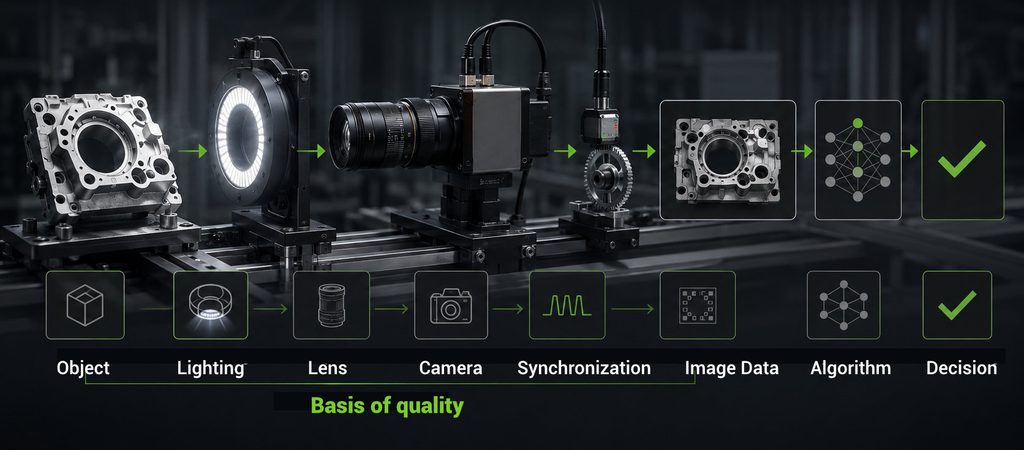
The success of a machine vision system therefore does not begin with training, but with image formation. Choosing the right camera, the appropriate optics, and a suitable resolution determines whether relevant features can be captured with sufficient clarity and reproducibility in the first place. If contrast is missing, details are not resolved, or the field of view does not match the task, this can subsequently be corrected by software only to a very limited extent.
Equally crucial is the illumination. Particularly in industrial applications, it often decisively determines whether a feature is stably visible or gets lost in process noise. Reflections, shadows, gloss, material inhomogeneities, or changing surface conditions can irritate an AI system just as much as classical algorithms. In addition, there is the geometric arrangement of the system, object position, and process repeatability. Only when these fundamentals are properly coordinated can AI truly leverage its strengths.
An often underestimated point is also the synchronization with the object to be inspected. In many applications, image acquisition and object movement must be precisely coordinated, for example via triggers or encoder signals. Motion blur should also not be dismissed as a minor side effect. It not only reduces image quality, but often directly impacts the reliability of subsequent evaluation.
The appropriate architecture
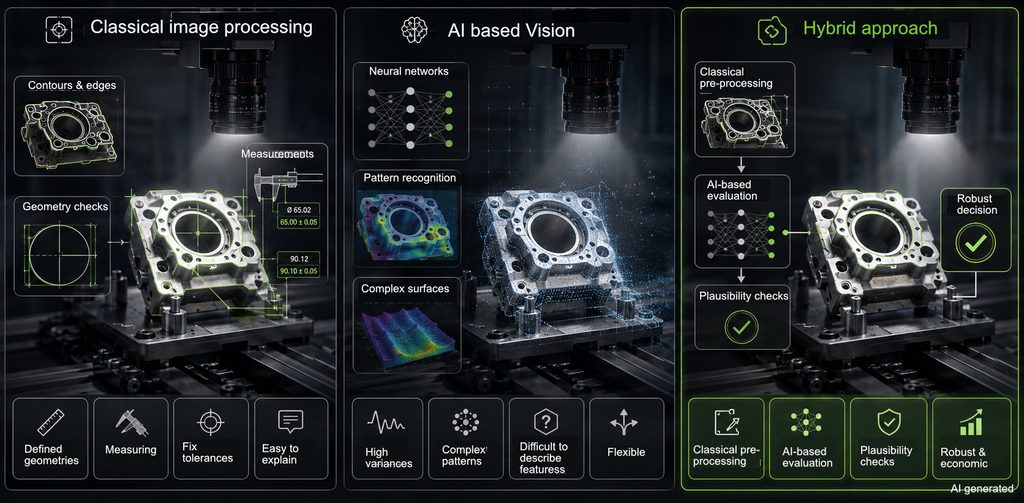
Particularly with clearly definable geometries, simple measurement tasks, completeness checks, or fixed tolerance criteria, classical methods are often more transparent, resource-efficient, and easier to validate. AI plays to its strengths rather where high variance, complex patterns, or hard-to-describe feature characteristics are present. The best solution is therefore often not the most "modern" one, but the most sensible one architecturally. Combining both worlds sensibly often results in more robust, more explainable, and more economical systems.
This is precisely why choosing an experienced system integrator is a key success factor in many cases. A good integrator does not just look at the AI model, but at the overall system: optics, camera, lighting, mechanics, process integration, database, software architecture, and subsequent operational readiness. Only this interplay creates an industrial solution that functions reliably in everyday operation.
Furthermore, an experienced partner usually brings something that is particularly valuable in the early stages of a project: the ability to identify risks early on . These include unclear requirements, unsuitable data, insufficient feature values, unstable process conditions, or unrealistic expectations regarding accuracy and generalizability. Addressing these issues early prevents later disappointments and reduces the risk of creating a repeat of the same problem.
Furthermore, there are other aspects that are often underestimated in practice: maintainability, retraining capability, expandability, and documented validation . machine vision system It must not only work in a demo, but also in ongoing operation, under real-world cycle conditions, and over an extended lifecycle. Changes to products, batches, variants, or environmental conditions are more the rule than the exception. An experienced system integrator plans for such changes from the outset.
Regulatory and security requirements are also gaining increasing importance. Especially with networked industrial systems, compliance with the Cyber Resilience Act (CRA) can be a crucial component of project implementation. An experienced integrator can not only handle the technical implementation but also systematically address documentation, responsibilities, update capabilities, and security requirements. For companies, this is a key difference between a short-term, impressive standalone solution and a sustainable, long-term system .
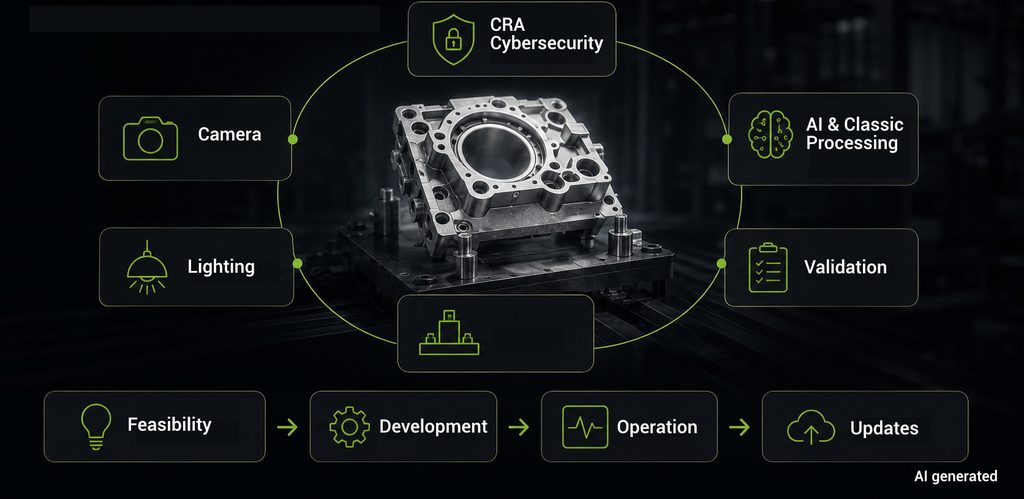
AI is therefore not the holy grail that the machine vision It has been waiting for ages. But, when used correctly, it is an extraordinarily powerful tool. The crucial point is not whether AI is used, but whether it is embedded in a clean, technically sound, and process-reliable overall solution. This is precisely where a quick demonstration differs from a truly robust industrial application.
Why experience is crucial
Often, it is a combination of classic, rule-based methods and AI-based components that leads to the best result.
Not every task needs to be solved with AI. In many cases, a solution that uses rule-based methods may be the more suitable choice.