
Artificial Intelligence (AI) in Machine Vision
Artificial Intelligence is a field of research aimed at developing machines that can learn, plan, and solve problems using intelligent algorithms.
An AI-based system is trained using a large number of examples and then attempts to generalize what it has learned to new problems—when used in the field of industrial machine vision, for example, to cover the entire variance of a production run.

The ability of AI to process large amounts of data quickly and learn from past experience makes it a valuable tool for machine vision as well. In practice, an AI system is fed a large number of images containing both objects and their surroundings. The system is then able to identify the objects being searched for and ignore the background. An AI system trained in this way can then be applied to new images to identify the desired objects with high accuracy.
Applications and AI Algorithms in Machine Vision
With artificial intelligence, images can be analyzed for their content, for example to find defects, extract edges, or classify objects. AI is mainly used in applications where the objects are highly variable and/or exhibit non-specific features or defect types.
CLASSIFICATION
Objects are assigned to a class based on predefined features.
OBJECT DETECTION
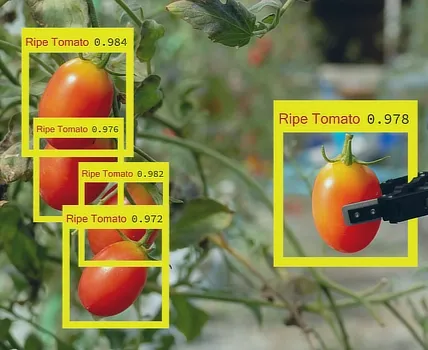
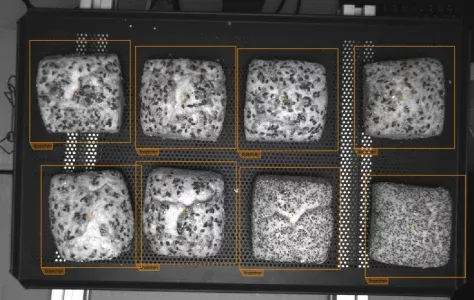
Trained objects are localized and identified, framed with a bounding box, and labeled.
SEMANTIC SEGMENTATION
Each pixel in the image is assigned a class. Trained defect classes can be localized with pixel precision.
ANOMALY DETECTION
Images of error-free objects are trained, and all deviations are detected.
EDGE EXTRACTION
Enables the extraction of edges that cannot be identified with conventional filters,
INSTANCE SEGMENTATION
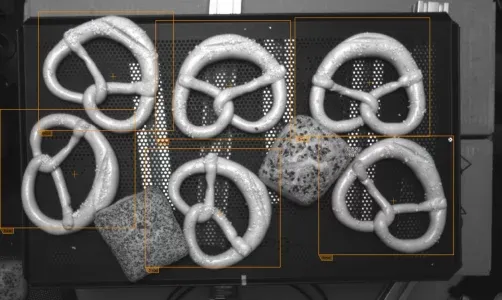
Combines object detection and semantic segmentation and is particularly helpful when objects are close together, touching, or overlapping.
DEEP OCR
Robust localization of characters regardless of orientation, font, and polarity.
The additional use of pretrained networks (CNNs = Convolutional Neural Networks and RNNs = Recurrent Neural Networks) makes it possible to develop applications even with a relatively small number of training images, meaning the algorithm analyzes the trained images and learns automatically which features can be used for identification.
The Limits of AI in Machine Vision
AI accuracy is influenced by factors such as image quality, the amount of information contained in the image, image resolution, and lighting. In practice, the AI is trained for a specific image resolution and can therefore only be as good as the images it was trained on. If image quality is poor and resolution is low, it is difficult for the AI to accurately analyze the image content. This may be due to a lack of detail in the image, making it harder for the AI to recognize the objects, or to visual noise such as dark or bright spots on the image that hinder object recognition.
In machine vision, however, it is important to focus precisely on these "spots" in an image, for example, to determine which of them are defects. This is where complex training processes come into play, requiring these "spots" to be framed, assigned to a class, and ensuring that no area in the image is overlooked or left unmarked. If, for instance, two features are still confused after this training, additional images featuring those exact characteristics must be used for training, and it is extremely important to correctly assign the respective class. Sometimes it is also necessary to delete images from the database that lead to confusion. However, this training, the necessary optimizations, and the resulting decisions require a great deal of experience and a high level of personnel effort.
Poor lighting conditions also frequently pose problems for AI-based approaches, and analyzing poorly lit images is extremely difficult. Even with defects that are not very clearly recognizable, distinguishing between production variance and actual defects is only possible after extensive training.
However, in our market, there is no other option than to proceed in exactly this way. The exception is the use of so-called Anomaly Detection, a method that does not identify what kind of defect is present, but only that a production variance exists. This may or may not be a defect.
This is precisely where human involvement comes back into play. If it is indeed a defect, no further "manual input" is required. In all other cases, however, retraining is necessary. This approach in turn requires a great deal of experience and care, which usually makes the use of AI relatively expensive. The advantage, however, is that no special programming skills are required, which significantly broadens the user base.
In combination with classical machine vision algorithms and a clever application of trained data, however, it is possible to generate very effective semi-automated training processes that save both time and money.
Benefits of combining AI and human expertise
By combining artificial intelligence and human expertise, images can be analyzed more accurately and faster than would be possible with manual analysis. This can help companies analyze all images, even those with poor resolution or quality, to make better-informed decisions. AI can also be used effectively for the rapid analysis of a large number of images, saving the user time.
By combining artificial intelligence and human expertise, images can be analyzed more accurately and faster than would be possible with manual analysis. This can help companies analyze all images, even those with poor resolution or quality, to make better-informed decisions. AI can also be used effectively for the rapid analysis of a large number of images, saving the user time.
While AI technology is certainly a powerful tool, on its own it is not enough to ensure reliable machine vision. For one thing, AI cannot measure, so it will continue to be necessary to combine AI technology with classical technology. For another, AI is only ever as good as the data available to it and requires a sufficient amount of image data for training, which must be properly labeled.
In our opinion, to ensure accurate and reliable machine vision, AI must be used in conjunction with other methods such as manual data entry and analysis by human experts. This combination then provides a powerful method for image analysis that enables companies to analyze images quickly and accurately, automate processes more efficiently, and improve quality control.