
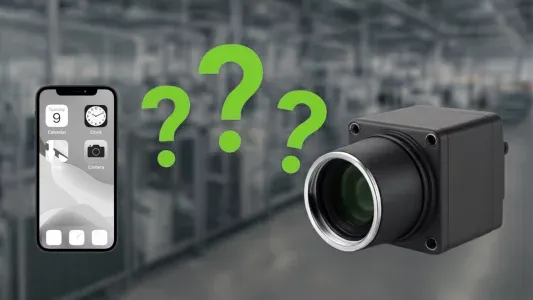
But what makes industrial cameras so much more powerful?
Lighting = half the battle
Reliable image evaluation requires defined, uniform, and powerful lighting. Smartphones conceal fluctuations using software, which looks visually appealing but leads to technically inconsistent results.
Precision instead of filter effects
Industrial cameras use global shutter sensors, ideal for moving processes and measurement tasks. Smartphones, on the other hand, almost always use rolling shutters—good for holiday photos, but unsuitable for precise measurements.
Robustness & Reliability
Industrial cameras are designed for 24/7 operation in harsh environments, and are resistant to vibration, dust, and temperature. A smartphone is a consumer product built neither for continuous operation nor for reliable assembly processes.
Optics & Focal Length
In industrial applications, optics and focal length must be precisely matched to object size, distance, and resolution. Mobile phone cameras usually offer only fixed, frequently wide-angle focal lengths with variable focus, which cannot be calibrated, for example.
Long-Term Availability
Industrial systems run for many years, setups must be reproducible, and components must remain interchangeable, maintainable, and available. Smartphones have extremely short lifecycles, and without reproducibility, no process can be validated.
Cybersecurity & Data Privacy
Regardless of the image, smartphones as a "system" involve numerous aspects that should not be underestimated. It starts with the question of where you can even reliably connect the traffic light for the OK signal on a smartphone. Furthermore, data exchange with peripherals is anything but trivial without defined industrial interfaces.
It gets even more critical one level down: a smartphone runs an arbitrary number of background apps and processes over which you have no influence, neither in terms of stability nor security. From our perspective, how such a system can be made compliant with current regulations like the GDPR, and above all the Cyber Resilience Act or the upcoming EU Machinery Regulation starting in 2027, is at the very least questionable.

Conclusion
Smartphone cameras deliver impressive images, but they do not measure, they do not guarantee process reliability, and they might no longer be available tomorrow.
If you want to achieve industrial quality, you need to think beyond the device price:
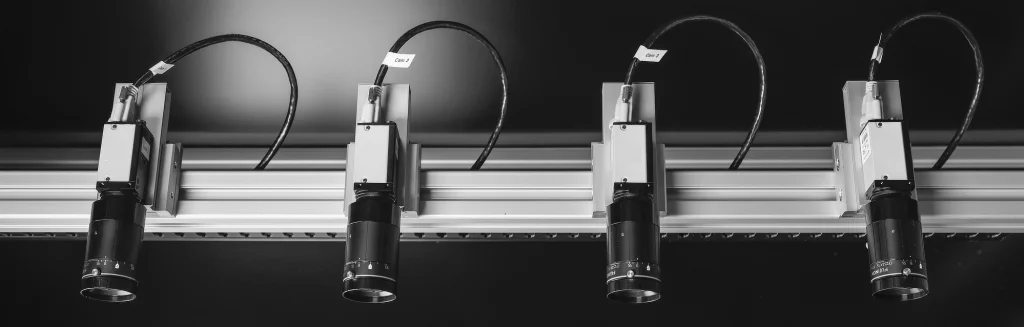
Industrial cameras stand for reliability, reproducibility, accuracy, and long-term availability.
Our Practical Tip
Before choosing a camera, clarify these 3 questions:
- Should the camera also measure or inspect, rather than just display?
- Do the background, lighting, or movement in the process change?
- Must the system be available and maintainable over the long term?
If you answer "yes" at least twice: ➔ Industrial camera.