

What happens behind the scenes?
So what really happens in those crucial milliseconds between trigger and decision? Join me as we take a look behind the curtain to discover the technical interplay that makes this apparent simplicity possible in the first place.

Lighting Engineering
It's not just about avoiding shadows and reflections. The light must be designed and directed in such a way that even the finest surface variations are visible evenly across the entire image field. At the same time, the spectral properties, coherence length, and temporal stability of the light source must be precisely controlled.

Optical precision
Telecentric lenses must be precisely matched to the sensor pixel size. Modulation transfer functions (MTF) need to be calculated, depth of field optimized, and thermal drift effects as well as mechanical tolerances in the micrometer range taken into account, all under real production conditions.

Perfect timing
A trigger is more than just a moment of initiation. It's about the precise coordination of exposure time, sensor readout architecture, and data pipeline latencies so that the exact right moment on the production line is captured in a fraction of a second.

Intelligent decisions
The algorithms must distinguish in real time between actual defects and harmless reflections or image noise. They analyze millions of pixels, backed by sound mathematics and optimized for reliable decisions.

Throughput Optimization
All of this happens at production speeds where a complete cycle takes just a few hundred milliseconds, not seconds. Every millisecond counts here.
This is industrial machine vision. It is not about "simply taking pictures."
Machine vision is applied physics, precise optical engineering, mathematical modeling, and highly integrated system architecture deployed under the most demanding conditions, perfectly synchronized.
The Engineering Paradox
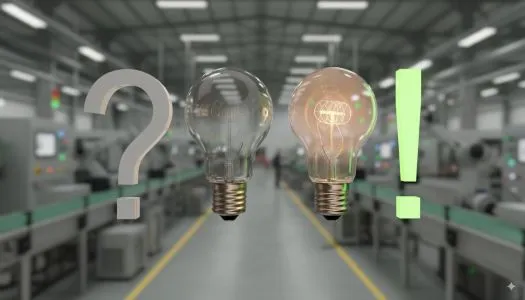
What fascinates me time and again about this discipline is that when our solutions work perfectly, they become invisible. The more sophisticated the engineering, the more effortless it appears.
The green light at the end of an inspection process represents hundreds of hours of development work—work that produces systems which function reliably even when actual production conditions go beyond what was originally specified.
In my series Behind the Pixels, I pull back the curtain to reveal the often invisible details that turn fragile setups into robust, reliable systems. I look at the technical challenges that only become apparent when you dig deep enough, and the decisions that make the difference between success and failure.
Because true simplicity in machine vision does not happen by chance. It is the result of mastering extremely complex relationships. And every "simple" green light is proof that everything is working exactly as it should.