Why diffused light works so well
Photographers used to refer to a "cloudy day" as ideal for shooting. This meant an evenly overcast sky, where soft light comes from all directions. It is precisely this characteristic that makes diffused light so valuable.
Applied to machine vision, this means: only when light strikes an object from as many directions as possible is there a chance at every point—following the rule that the angle of incidence equals the angle of reflection—that photons find their way to the sensor across every area of the surface. Diffuseness is therefore ideal for our "path of light."
The result: fewer harsh shadows, fewer issues with reflections, and very even illumination. If the goal is not targeted contrast enhancement, but rather making as many details visible as possible, then diffused light is the right choice.
Dome lighting
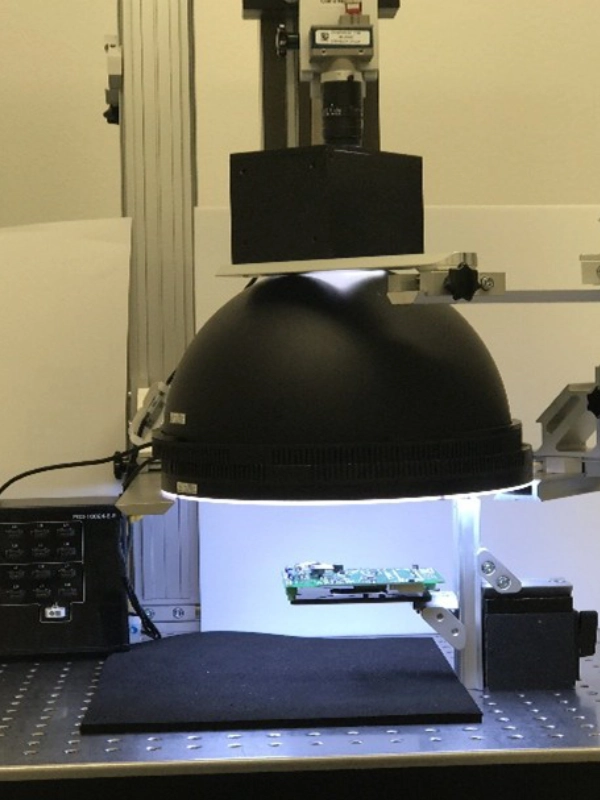
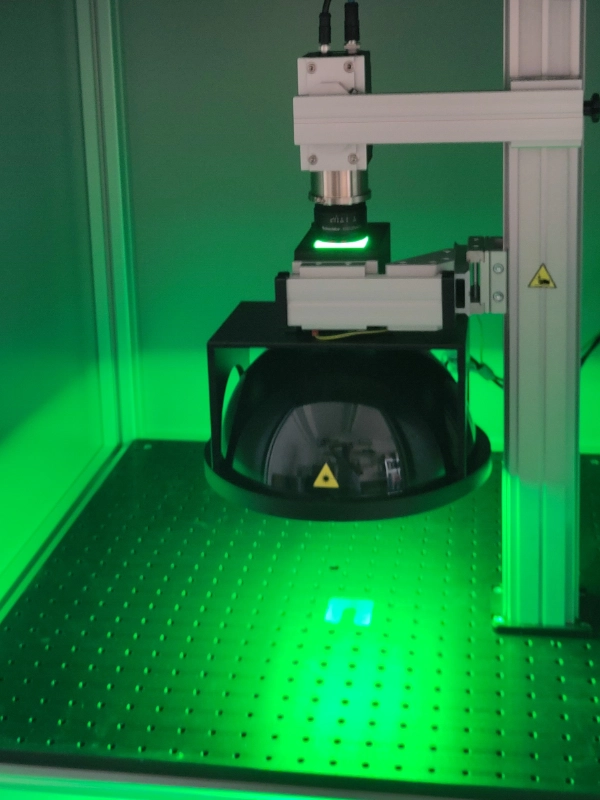
The best solution for truly diffuse front lighting is the dome. Simply put, this is a half integrating sphere. From a physics perspective, a complete integrating sphere is the only setup that generates truly, ideally diffuse light. Those who wish to delve deeper will find numerous explanations online.
The dome light utilizes this principle very effectively. The light is scattered multiple times and strikes the object from virtually all directions. This ensures that even complex surfaces are reliably revealed.
Diffuse illumination for large objects
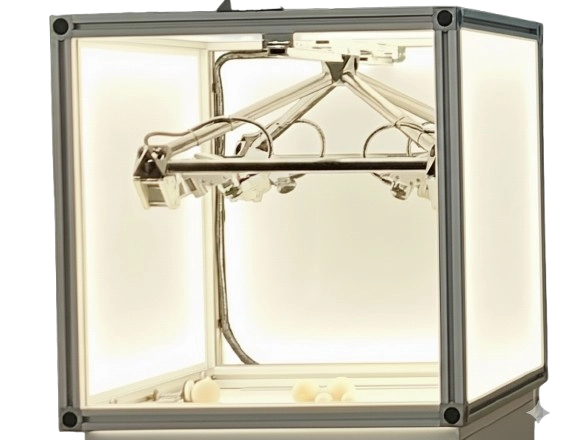
In industrial practice, however, dome lights are not always ideal. Especially with larger objects, they quickly reach their geometric limits. This is why we rely on a "cube" made of extremely diffuse light panels in many applications.
This exact approach led to the creation of our pvLight — a flexible, highly homogeneous, diffuse lighting solution for larger inspection objects. The goal was to translate the advantages of the dome principle into a practical and scalable format.